

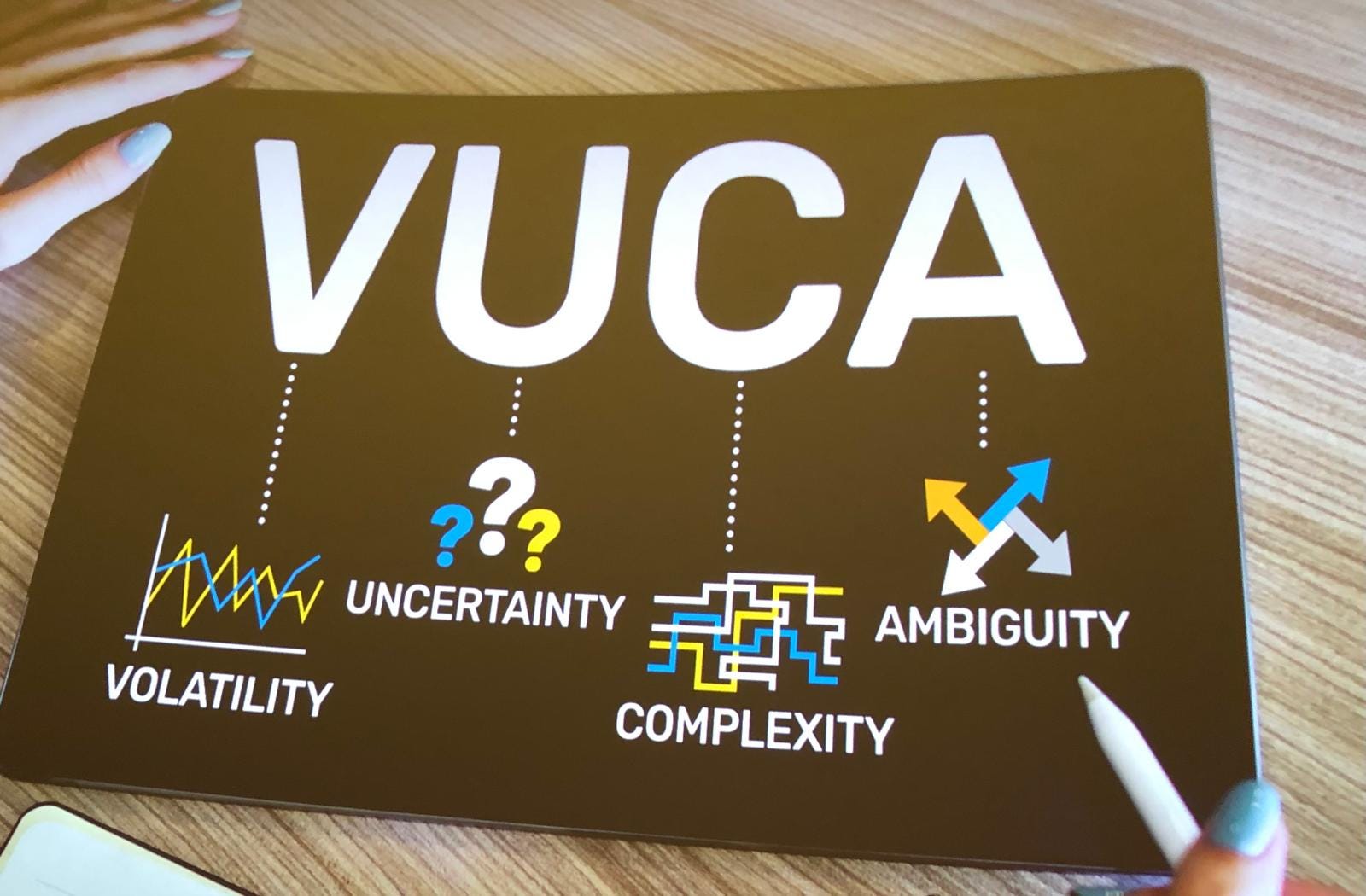
We live and work in a world that feels increasingly unstable.
Volatile.
Uncertain.
Complex.
Ambiguous.
VUCA is no longer a theoretical framework from military strategy textbooks. It’s Tuesday morning in your organization.
Add to that:
Climate transitions
Digital transformation
AI disruption
Budget cuts and reorganizations
Shifting citizen expectations
Talent shortages
Political polarization
And suddenly we’re not just dealing with “problems.”
We’re dealing with wicked problems.
What Makes a Problem Wicked?
Wicked problems:
Have no clear definition
Have no single right answer
Involve many stakeholders with conflicting perspectives
Change while you’re trying to solve them
Cannot be solved once and for all
Healthcare reform. Urban development. Digital inclusion. Youth unemployment. Organizational transformation.
You don’t “fix” them.
You navigate them.
And that’s where service design becomes essential.
Service Design as a Navigation System
Service design is often misunderstood as post-it notes, workshops, or journey maps.
But at its core, service design is something much deeper:
A structured way of thinking and working in complexity.
It helps organizations move from:
Assumptions → Insight
Silos → Systems
Opinions → Evidence
Big ideas → Tested prototypes
Fear → Learning
In a VUCA world, service design doesn’t remove uncertainty.
It makes uncertainty workable.
1. From Chaos to Clarity
In volatile environments, people rush to solutions.
Service design slows us down just enough to ask:
What problem are we actually trying to solve?
For whom?
In what context?
What does success look like?
Through stakeholder mapping, user research, system visualization, and journey mapping, complexity becomes visible.
And once you can see the system, you can start influencing it.
2. From Complexity to Collaboration
Wicked problems live between departments.
But most organizations are structured in silos.
Service design brings:
Cross-functional workshops
Co-creation sessions
Shared language
Collective sense-making
Instead of fighting complexity, teams learn to hold it together.
This builds alignment, ownership, and psychological safety — all prerequisites for innovation in uncertain environments.
3. From Risk Avoidance to Safe Experimentation
In ambiguous situations, many organizations freeze.
Service design introduces prototyping as a mindset:
Test small
Learn fast
Reduce risk early
Iterate continuously
Instead of betting everything on a five-year master plan, you create learning loops.
In a VUCA world, adaptability is more valuable than certainty.
4. From Outputs to Real Value
Many organizations measure activity:
Number of projects
Number of initiatives
Number of digital tools launched
Service design shifts the focus to outcomes:
Did it create value for users?
Did it simplify processes?
Did it reduce friction?
Did it improve trust?
Did it increase engagement?
In complex systems, value is relational and systemic — not just transactional.
The Deeper Layer: State of Mind in Complexity
Here’s something we rarely talk about.
Navigating wicked problems is not only about tools and methods.
It’s about state of mind.
In VUCA environments:
Fear rises
Control tightens
Defensiveness increases
Blame spreads
But service design, when practiced well, cultivates:
Curiosity
Openness
Empathy
Systems thinking
Shared responsibility
The external complexity mirrors our internal state.
When leaders operate from clarity rather than fear, complexity becomes manageable.
When teams feel safe, creativity emerges.
When organizations listen deeply, innovation follows.
Service Design Is Not About Control
It’s about:
Seeing the whole system
Engaging the right people
Learning continuously
Designing with, not for
Creating value that lasts
In a VUCA world, control is an illusion.
But direction is not.
Service design provides direction.
If You’re Facing a Wicked Problem Right Now
Ask yourself:
Have we truly understood the problem?
Have we involved the people affected?
Have we visualized the system?
Are we testing small before scaling big?
Are we measuring real value — or just activity?
If the answer to several of these is “no,” you don’t need more pressure.
You need better design.
Final Thought
VUCA is not going away.
Wicked problems will not disappear.
But organizations that embrace service design as a way of thinking — not just a toolkit — will:
Move faster with less chaos
Collaborate better across silos
Reduce waste and friction
Create meaningful, measurable value
And build resilience for whatever comes next
The question is not whether your organization faces complexity.
The question is:
Do you have a way to navigate it?
Ready to Navigate Complexity Differently?
If your organization is facing:
A messy transformation
A stalled innovation initiative
Cross-silo friction
Unclear direction
A wicked problem that refuses to “go away”
You don’t need more pressure.
You need clarity, alignment, and a structured way to move forward.
That’s where I can help.
As a Senior Service Designer and Innovation Lead with deep experience navigating complexity in both public and private sectors, I help leaders and teams:
Make sense of messy systems
Align stakeholders around real problems
Design practical, testable solutions
Create measurable value — not just activity
I’m currently available and actively looking for new professional challenges where I can contribute strategically and hands-on.
If you’re working on something complex and important — let’s talk.
Send me a message.
Book a coffee.
Wicked problems don’t solve themselves.
But with the right mindset and the right design approach, they become navigable.
Let’s design value in complexity, together.