

Many teams complain about meetings.
Too many meetings.
Too long meetings.
Meetings that could have been emails.
But the real problem is rarely the number of meetings.
The real problem is lack of intentional design.
Most meetings simply happen because they always have. Over time they become rituals nobody questions anymore. People show up out of habit rather than purpose.
A much more productive approach is to design your meetings deliberately as a team.
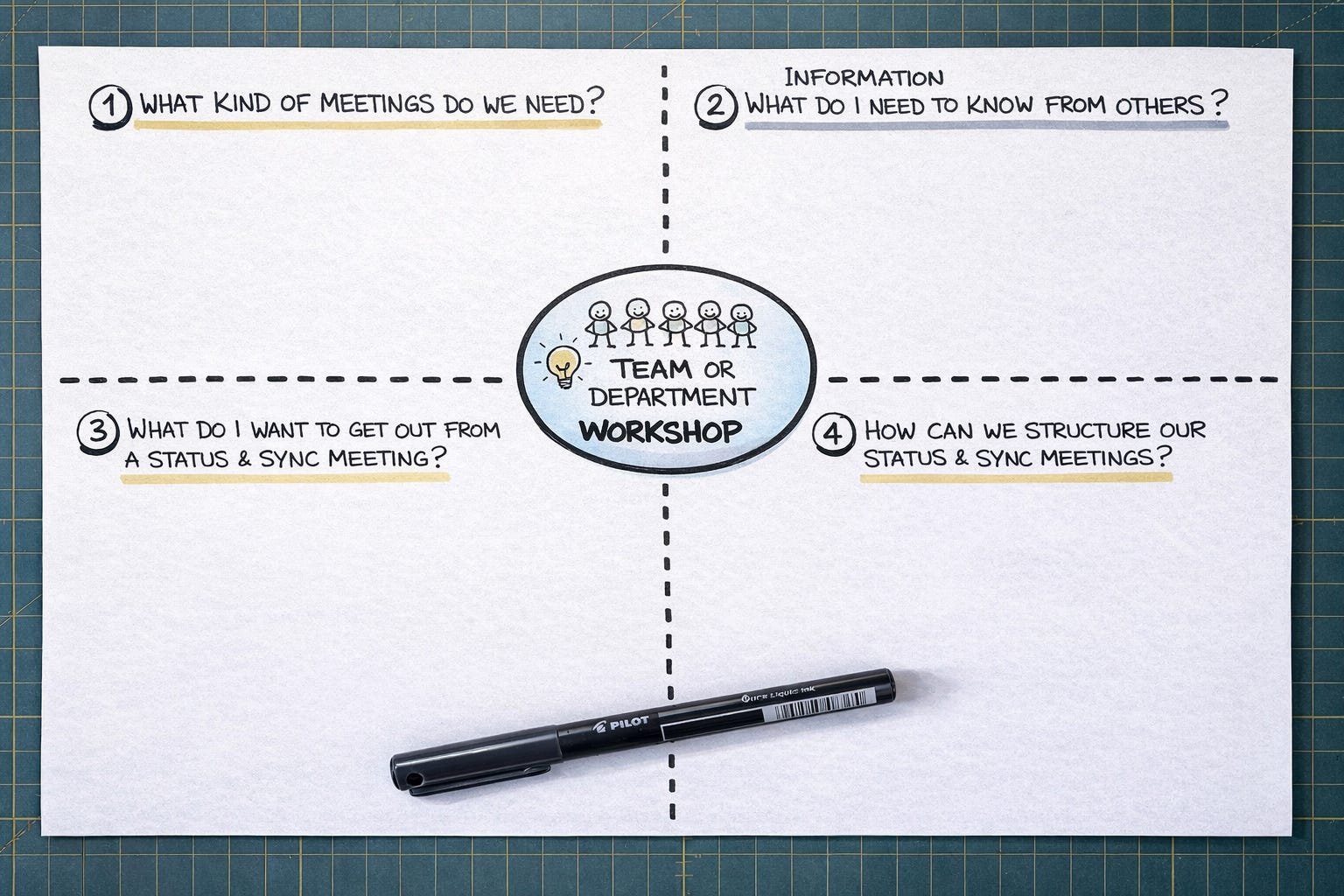
One of the most powerful ways to do this is through a simple team or department workshop where people collectively clarify:
What meetings they actually need
What information they need from each other
What they expect from status and sync meetings
And how these meetings should be structured
This article outlines a facilitation approach you can use to run exactly that workshop.
Why run a “Meeting Design Workshop”?
Meetings are essentially coordination infrastructure.
They are the mechanism through which teams:
Share information
Align direction
Solve problems
Make decisions
Maintain momentum
When meetings are poorly designed, the entire organization slows down.
But when meetings are clear, purposeful, and well structured, they become powerful enablers of collaboration.
A meeting design workshop helps teams:
Reduce unnecessary meetings
Clarify expectations
Improve information flow
Increase focus and productivity
Create shared ownership of meeting culture
And importantly: the team co-designs the solution.
The 4 Conversations Every Team Needs
A simple way to structure the workshop is with four key questions.
Each question unlocks a different part of the meeting system.
1. What kind of meetings do we actually need?
Start by mapping the types of meetings the team needs.
Not every meeting serves the same purpose.
Common categories include:
Decision meetings
Making strategic or operational decisions
Problem-solving meetings
Tackling complex challenges together
Status & sync meetings
Sharing updates and alignment
Planning meetings
Prioritization and upcoming work
Learning / reflection meetings
Retrospectives and continuous improvement
Creative workshops
Generating ideas and exploring possibilities
Facilitation tip:
Ask participants to write meetings they believe are necessary on sticky notes and cluster them together.
You will often discover that several meetings serve overlapping purposes and can be merged.
2. What information do we need from each other?
Many meetings exist simply because information flow is unclear.
Ask the team:
What do you need to know from others to do your job well?
What information do others need from you?
What information is missing today?
This conversation surfaces the dependencies inside the team.
Often teams realize:
Some information should be shared asynchronously
Some updates are unnecessary
Some critical information is never communicated
By clarifying information needs, meetings become intentional communication channels instead of information dumping grounds.
3. What should a status & sync meeting give us?
Status meetings are often the most common and criticized meetings.
The problem is usually simple:
Nobody has agreed on what the meeting is actually for.
Ask the group:
What should we walk away with after a good status meeting?
Typical answers include:
Shared awareness of progress
Visibility of risks and blockers
Alignment on priorities
Quick decisions where needed
Clear next steps
Once expectations are clear, teams often realize status meetings should focus on exceptions rather than reporting.
Instead of long updates, the meeting becomes:
What changed
What is blocked
Where help is needed
4. How should our meetings be structured?
Finally, the team designs the operating system of their meetings.
Discuss and agree on:
Frequency
Daily
Weekly
Monthly
Quarterly
Duration
15 minutes
30 minutes
60 minutes
Agenda structure
Example for a weekly sync:
Key updates (5 min)
Risks and blockers (10 min)
Decisions needed (10 min)
Coordination & next steps (5 min)
Roles
Clarify who:
Facilitates the meeting
Keeps time
Documents decisions
Good meetings rarely happen by accident.
They are carefully structured containers for collaboration.
A Simple Workshop Agenda (90 minutes)
Here is a practical facilitation structure.
1. Context (10 min)
Explain why the team is redesigning its meeting system.
2. Meeting types (20 min)
Identify and cluster the meetings the team actually needs.
3. Information needs (20 min)
Map what information people need from each other.
4. Status meeting expectations (20 min)
Define what success looks like for sync meetings.
5. Structure & agreements (15 min)
Design the format, frequency and agenda.
6. Wrap-up (5 min)
Capture agreements and next steps.
At the end, the team should have a clear meeting architecture.
The Hidden Benefit: Ownership
When leaders redesign meetings alone, the team often resists the changes.
When the team co-creates the system, something different happens.
People feel ownership.
They understand why meetings exist.
And they become more disciplined about making them work.
Meetings stop being a burden and become tools for collaboration.
Final Reflection
Meetings are not the problem.
Unintentional meetings are.
A short workshop like this can transform the way a team collaborates by turning meetings from default habits into deliberately designed interactions.
When teams design their own meeting system, they create:
Better focus
Better information flow
Better decisions
Better use of time
And perhaps most importantly:
More meaningful conversations.
If you want help facilitating this in your organization
Designing productive meetings is a surprisingly powerful lever for improving collaboration, leadership and team effectiveness.
If your team struggles with meeting overload, unclear communication, or lack of alignment, I help organizations run facilitated workshops to redesign their collaboration systems.
Reach out if you would like support facilitating a Meeting Design Workshop with your team or department.