

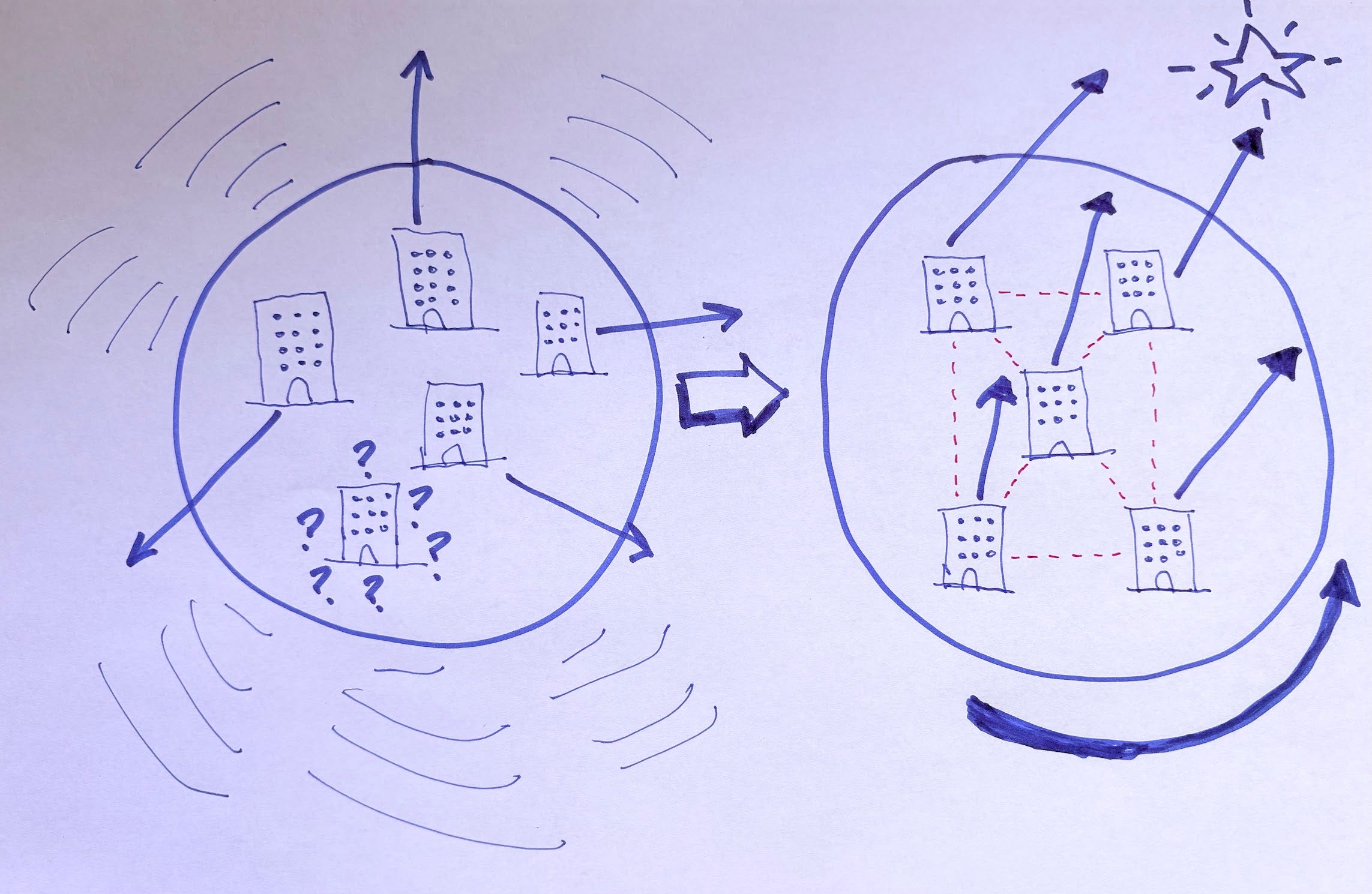
We’ve been taught that strategy is about clarity, control, and planning.
Define the vision.
Break it down.
Execute.
But what happens when the context keeps shifting?
When people don’t align as expected?
When reality refuses to follow the plan?
This is where emergent strategy comes in.
What is emergent strategy?
Emergent strategy is the idea that strategy doesn’t have to be fully designed upfront—it can evolve through action, interaction, and learning over time.
Instead of asking:
What is the perfect plan?
It asks:
What is the next meaningful step—and what can we learn from it?
It’s not about abandoning direction.
It’s about holding direction lightly while letting the path emerge from reality.
Small actions.
Real feedback.
Continuous adaptation.
Over time, those small moves shape something much bigger than any plan could have predicted.
Why it matters (now more than ever)
Most organizations are not operating in stable environments anymore.
They are navigating:
Complexity instead of clarity
Interdependencies instead of silos
Constant change instead of predictable cycles
In this context, traditional strategy often creates:
False certainty
Slow decision-making
Plans that look good on paper but fail in practice
Emergent strategy offers a different path.
It allows organizations to:
Move faster without needing perfect answers
Learn before scaling
Adapt based on what actually works—not assumptions
It shifts strategy from a document…
to a living practice.
What changes in leadership
This is where the real transformation happens.
Emergent strategy doesn’t just change how we plan.
It changes how we lead.
1. From control → to conditions
Leadership is no longer about controlling outcomes.
It’s about creating the conditions where good outcomes can emerge:
clarity of intention
psychological safety
space to experiment
strong feedback loops
Less directing.
More enabling.
2. From knowing → to learning
Leaders are not expected to have all the answers.
Instead, they:
ask better questions
pay attention to what’s happening
adapt based on signals from the system
Leadership becomes sense-making in motion.
3. From big plans → to small moves
Progress doesn’t come from massive initiatives.
It comes from:
small, intentional experiments
quick feedback
continuous adjustment
Not:
“Let’s get it right”
But:
“Let’s make it better—step by step”
4. From alignment meetings → to shared ownership
Alignment is no longer achieved through presentations.
It grows through:
participation
co-creation
shared learning
People support what they help create.
And emergent strategy makes that visible.
A simple way to practice it
You don’t need to redesign your entire organization to start.
You can begin with a simple loop:
Set direction → Try something small → Learn → Adapt → Repeat
That’s it.
Strategy is no longer something you have.
It’s something you do.
Final reflection
Emergent strategy requires a different kind of courage.
Not the courage to make bold plans.
But the courage to:
move without full certainty
listen deeply
change direction when needed
It asks leaders to let go of control…
and trust the process of learning and adaptation.
Because in complex systems, the best strategy is rarely the one we design.
It’s the one that emerges from what we actually do—together.
Try this
Before your next strategy session, pause and ask:
What’s one small step we can take this week?
What are we curious to learn?
How will we notice if things are shifting?
Then act.
Not perfectly.
But intentionally.
Facili-Station
If this resonates with you, you’ll probably enjoy Facili-Station—a space for leaders, facilitators, and change-makers who want to:
turn complexity into clarity
lead through facilitation (not control)
design better conversations, decisions, and outcomes
→ Subscribe for practical tools, reflections, and real-world approaches to leadership and transformation:

Great explanation of the leadership implications of emergent strategy Jose :) I'd maybe add something about distributed decision-making / authority to experiment too. I was facilitating a strategy training yesterday and a really interesting convo came up about this - emergent ways of working need to be intentional; sometimes what looks like emergence is actually a knee jerk response to unanticipated change, really got me thinking!
Love this read, and love the quote ‘trust the process of learning and adaptation.’