

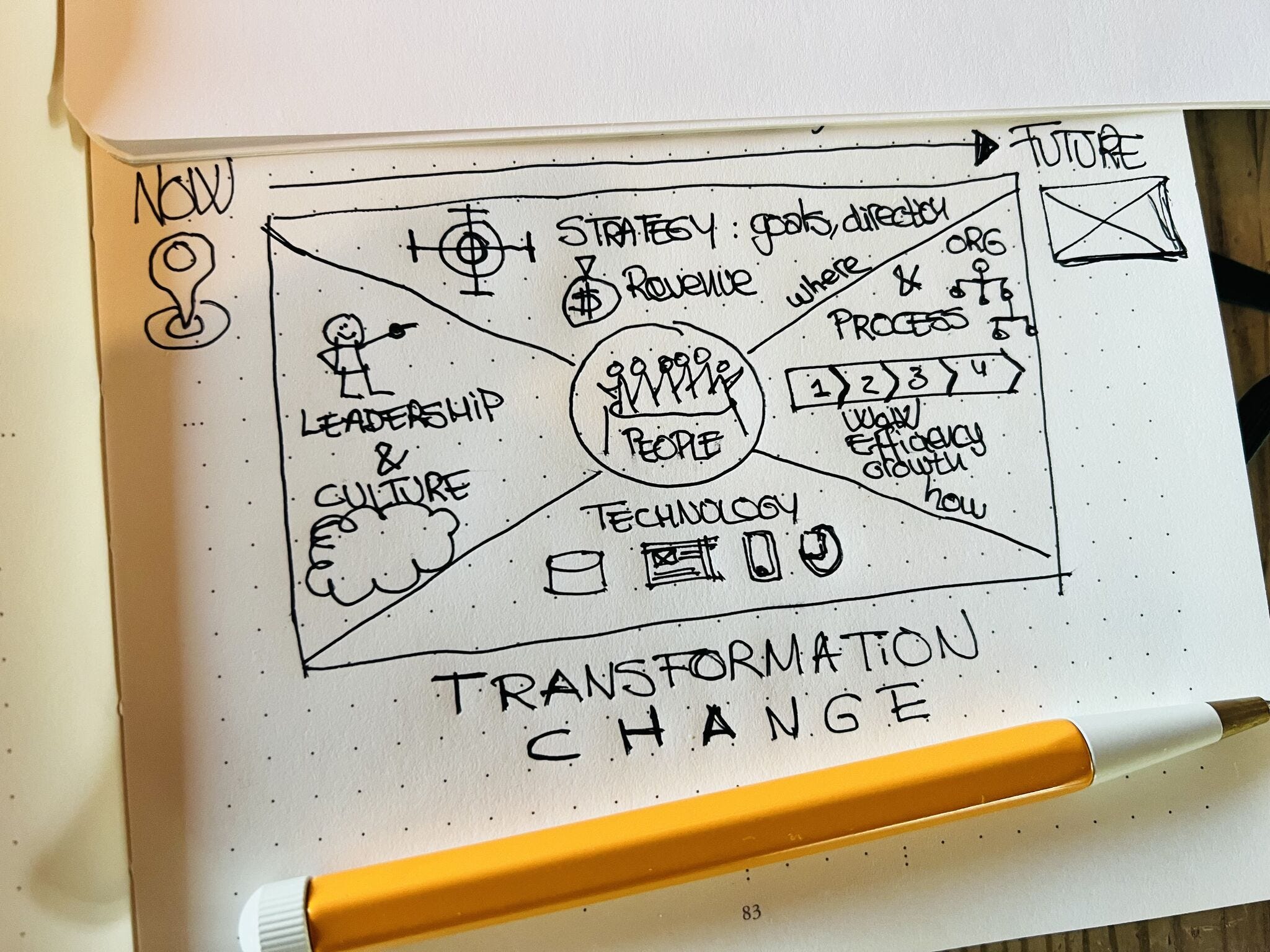
Transformation is not a project.
It is a shift from now to future — across strategy, structure, processes, technology, and culture — with people at the center.
The sketch above captures a powerful truth: transformation is multi-dimensional. If you over-focus on one element, you destabilize the whole system. If you hold them together, you create momentum.
Here is how I think about leading transformation journeys and where leaders should focus.
1. Start With Direction: Strategy and Revenue
Transformation without direction creates noise.
Before launching initiatives, clarify:
What future are we moving toward?
What strategic choices are we making?
How does this create value — for customers, society, and the business?
Where will revenue or impact come from?
Too many organizations jump into tools and restructuring without strategic clarity. Transformation must answer the “where and why” before the “how.”
Clarity reduces resistance. Ambiguity increases it.
2. Put People at the Center — Not as an Afterthought
At the center of the drawing is one word: People.
Not technology. Not process. Not structure.
People.
Transformation succeeds or fails based on:
Psychological safety
Trust in leadership
Ownership and engagement
Capability and competence
State of mind
You cannot impose transformation. You can only invite people into it.
That requires listening, involvement, and co-creation. When people understand the purpose and feel part of the solution, energy replaces resistance.
3. Align Leadership and Culture
Strategy may be written on slides.
Culture is lived in meetings.
If leadership behavior does not match the transformation narrative, credibility collapses.
Ask:
Are leaders modeling the change?
Are incentives aligned with the new direction?
Are we rewarding collaboration or protecting silos?
Is experimentation safe?
Culture is not changed by communication campaigns.
It shifts when leadership behavior shifts.
4. Redesign Processes for Flow, Not Control
Transformation often exposes friction:
Slow decision cycles
Handover bottlenecks
Redundant approvals
Lack of clarity in roles
Instead of layering more governance, redesign for flow:
What decisions can move closer to the frontline?
What steps create no real value?
Where are we optimizing locally but harming the whole?
Efficiency is not about doing more.
It is about removing what no longer serves.
5. Clarify Organizational Structure
Structure should support strategy — not resist it.
If you are aiming for customer-centricity but your organization is siloed by function, friction is guaranteed.
Transformation questions:
Do we organize around customers, products, or internal departments?
Are roles and mandates clear?
Is accountability visible?
Structure communicates priorities more loudly than strategy documents ever will.
6. Use Technology as an Enabler — Not the Driver
Technology appears in the drawing as tools — databases, systems, devices.
Technology should enable:
Better decisions
Simpler workflows
Improved user experience
Scalable value creation
But technology alone never transforms an organization.
Digital transformation fails when it becomes a system implementation instead of a behavioral shift supported by technology.
7. Manage the Journey Between “Now” and “Future”
Transformation is a journey across tension:
Stability vs. change
Efficiency vs. experimentation
Short-term performance vs. long-term direction
Leaders must hold this tension without overreacting.
Progress rarely looks linear. There will be confusion, fatigue, and pushback.
The key is rhythm:
Clear milestones
Visible quick wins
Ongoing communication
Continuous feedback loops
Transformation is less about one big launch and more about sustained movement.
8. Integrate — Don’t Fragment
The biggest risk in transformation is fragmentation:
Strategy team working separately from operations
HR driving culture initiatives disconnected from business goals
IT implementing tools without user insight
Leadership talking change without redesigning processes
The drawing reminds us: all elements are connected.
Transformation leadership is about integration.
Seeing the whole system.
Designing across boundaries.
Connecting dots others don’t see.
Final Thought: Transformation Is Human Before It Is Structural
Organizations don’t transform.
People do.
If you focus only on structure, you get compliance.
If you focus on people, clarity, and alignment, you get commitment.
Transformation journeys are complex — but they become manageable when you work systemically:
Strategy gives direction
Structure gives shape
Process gives flow
Technology gives enablement
Leadership and culture give energy
People make it real
And that journey — from “Now” to “Future” — is where true value is created.
Ready to Lead a Transformation — But Want to Do It Right?
If your organization is:
Navigating restructuring or downsizing
Redesigning processes for efficiency and impact
Clarifying strategy and direction
Strengthening leadership and culture
Implementing digital or service transformation
Trying to move from silos to collaboration
… you don’t have to do it alone.
I am currently available and actively looking for new professional challenges where I can contribute as a Senior Service Designer, Innovation Lead, and Transformation Facilitator.
I help leaders and teams:
Align strategy with execution
Simplify complexity
Improve processes and decision flows
Build engagement and ownership
Design transformation journeys that actually stick
If you are leading or preparing for a transformation journey and want to approach it in a more integrated, human-centered way and you need someone who can connect strategy, people, structure, process, and technology — and turn ambition into movement — I am always open for a conversation.
📩 Send me a message.
☕ Book a coffee.
🤝 Or introduce me to someone leading change who could use support.
Transformation is too important to approach randomly.
Let’s design it intentionally — together.