

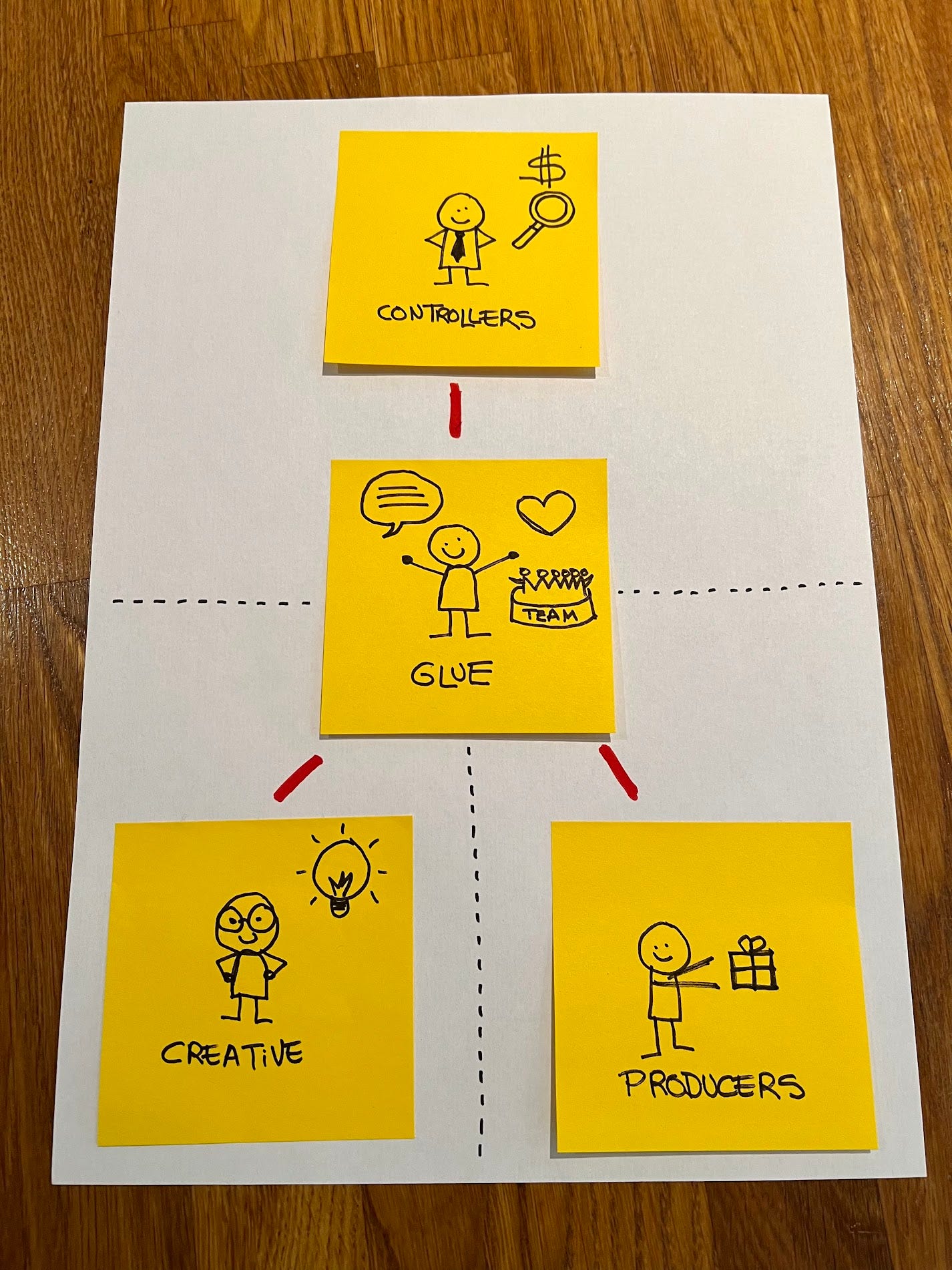
I like simple drawings.
They often say more about organizations than 200-slide strategy decks.
In this image, four roles appear: Controllers, Creatives, Producers, and at the center, Glue. It looks almost playful. But it captures something essential about how products and services actually come to life.
At its core, product and service development is not about ideas.
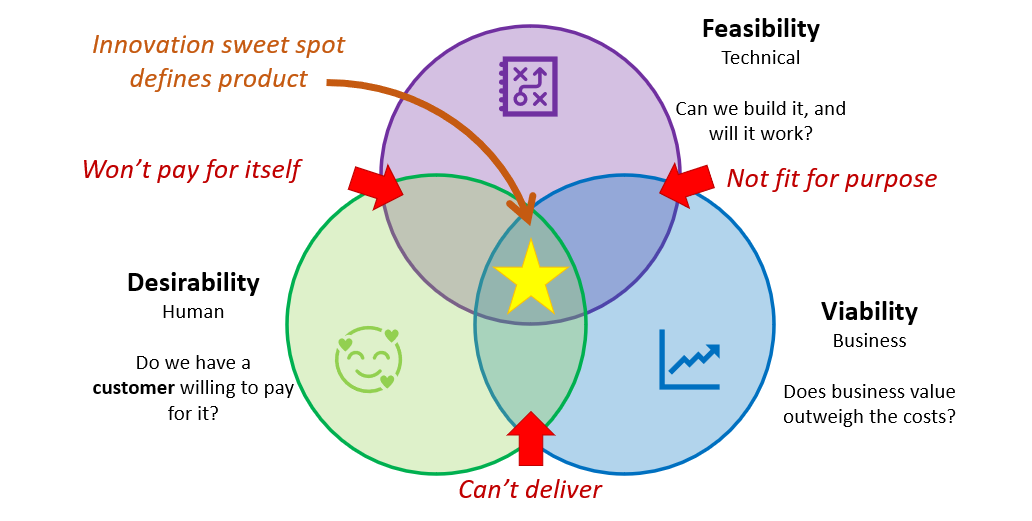
It is about holding three forces in tension:
Desirability – Do people actually want this?
Feasibility – Can we realistically build and sustain it?
Viability – Does it make business sense?
When one dominates, the system tilts.
Viability – The Logic of Sustainability
The Controllers represent viability.
They care about:
Financial health
Strategic alignment
Risk
Measurable outcomes
Without viability, innovation becomes expensive experimentation. We build things that impress but do not endure.
But when viability dominates, fear quietly shapes decisions. Short-term control replaces long-term courage. Exploration shrinks.
Viability is not the enemy of innovation. It is its stabilizer. But it cannot lead alone.
Feasibility – The Discipline of Delivery
The Producers represent feasibility.
They care about:
Capacity
Competence
Systems
Processes
Operational reality
They live in the tension between ambition and resources.
Without feasibility, strategy remains conceptual. Roadmaps become fiction. Teams burn out trying to deliver what the system cannot support.
But when feasibility dominates, the organization slowly becomes allergic to change. “This is how we do things” hardens into culture.
Feasibility is not about limitation. It is about responsible realization.
Desirability – The Courage to Care About Users
The Creatives represent desirability.
They ask:
Does this solve a real problem?
Is it intuitive?
Does it matter to people?
Is there product–market fit?
Without desirability, organizations become efficient at producing irrelevance.
But when desirability stands alone, ideas remain beautiful and disconnected from reality.
Desirability gives direction.
Feasibility gives structure.
Viability gives endurance.
The Most Undervalued Capability: Glue
At the center sits Glue.
The one who:
Connects finance and design
Translates constraints into creative possibilities
Aligns delivery teams with strategic intent
Holds difficult conversations
Builds shared understanding
Glue is rarely a formal job title. It often shows up in:
Strong product leaders
Service designers
Innovation leads
Facilitators
Mature product owners
Glue is not soft. It is systemic.
Without Glue:
Controllers push back.
Creatives push forward.
Producers protect stability.
Silos win.
With Glue:
Trade-offs become conscious.
Tension becomes productive.
Decisions become clearer.
Most organizations do not struggle because of lack of talent.
They struggle because no one is intentionally holding the whole system together.
A Quiet Diagnostic
If you look at your current context, where is the imbalance?
Are financial controls suffocating experimentation?
Are delivery teams overloaded and reactive?
Are user insights disconnected from strategic priorities?
Or is no one bridging the conversations that matter most?
The quality of your products often reflects the quality of the conversations between these roles.
Product Excellence Is an Orchestration Problem
Great product and service development is not about maximizing one dimension.
It is about consciously orchestrating:
What users need
What teams can sustain
What the business can support
And developing the capability to move between these perspectives without losing alignment.
That orchestration does not happen by accident. It is designed.
If You Are Navigating This Tension
Many leaders I speak with feel this pressure:
Finance pulling one way
Delivery teams overwhelmed
User expectations evolving
Strategy unclear
If you are working in that space, trying to create coherence across disciplines, reduce friction, and strengthen collaboration, this is precisely the work I support.
Through facilitation, advisory work, and coaching, I help leaders and teams:
Clarify strategic intent
Strengthen cross-functional dialogue
Navigate complexity without oversimplifying
Build stronger “Glue” capabilities inside the organization
If this reflection resonates with where you are right now, let’s have a conversation.
Sometimes what organizations need most is not a new framework.
It is better alignment between the people already there.