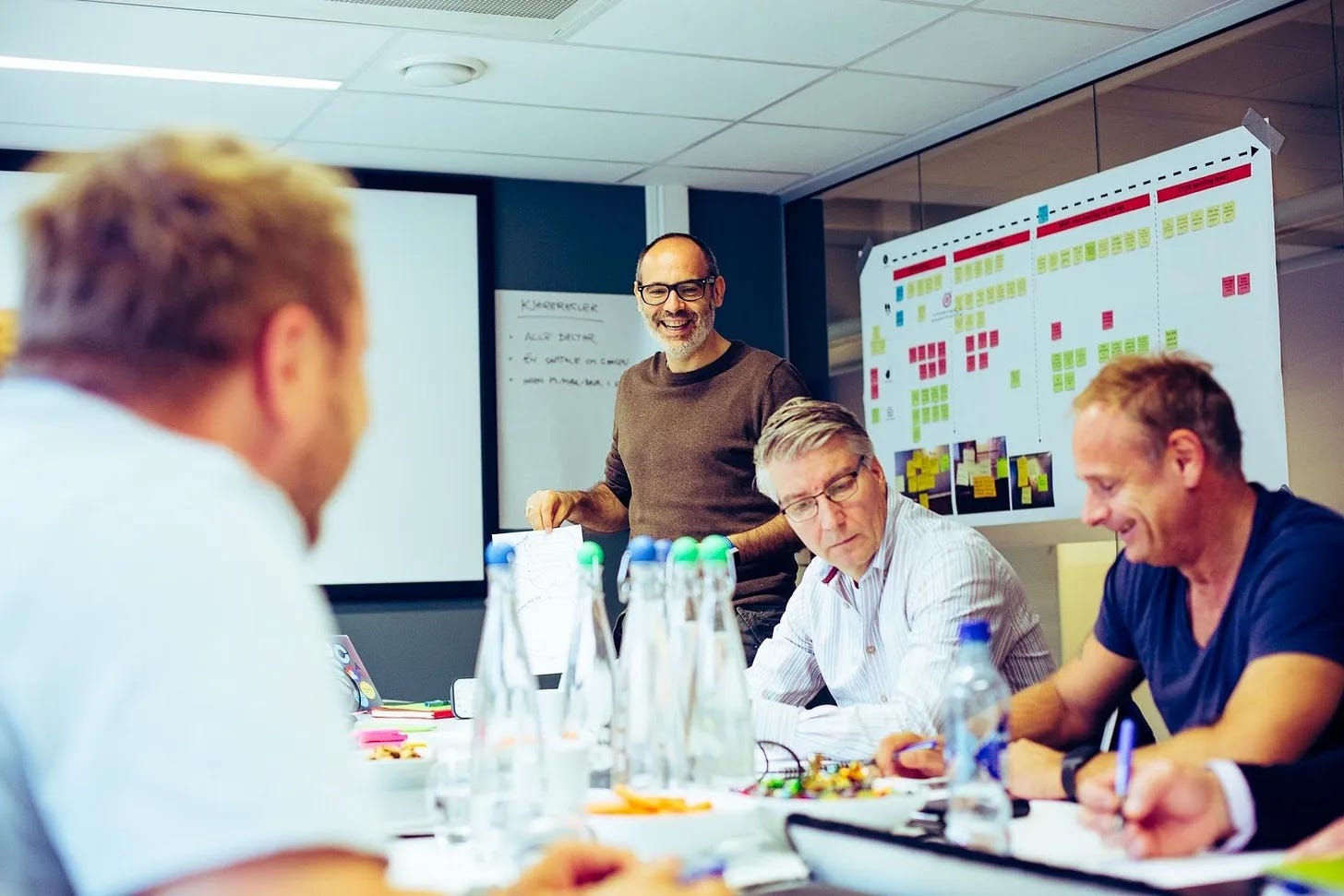
A few weeks ago I facilitated a strategy session for a leadership team. Nice people. Smart people. Well prepared.
Maybe a bit too well prepared.
Three of them walked in with a full strategy draft each. Clean structure, nice wording, even a SWOT. All three had been made with AI the evening before. All three looked finished. And all three pointed in different directions.
We spent the first hour not deciding anything. We were just trying to understand what each draft was actually saying, and why. Nobody had done anything wrong. Everyone had done their homework. Still, we were further from a decision than if they had come with a blank sheet of paper.
That’s when it hit me:
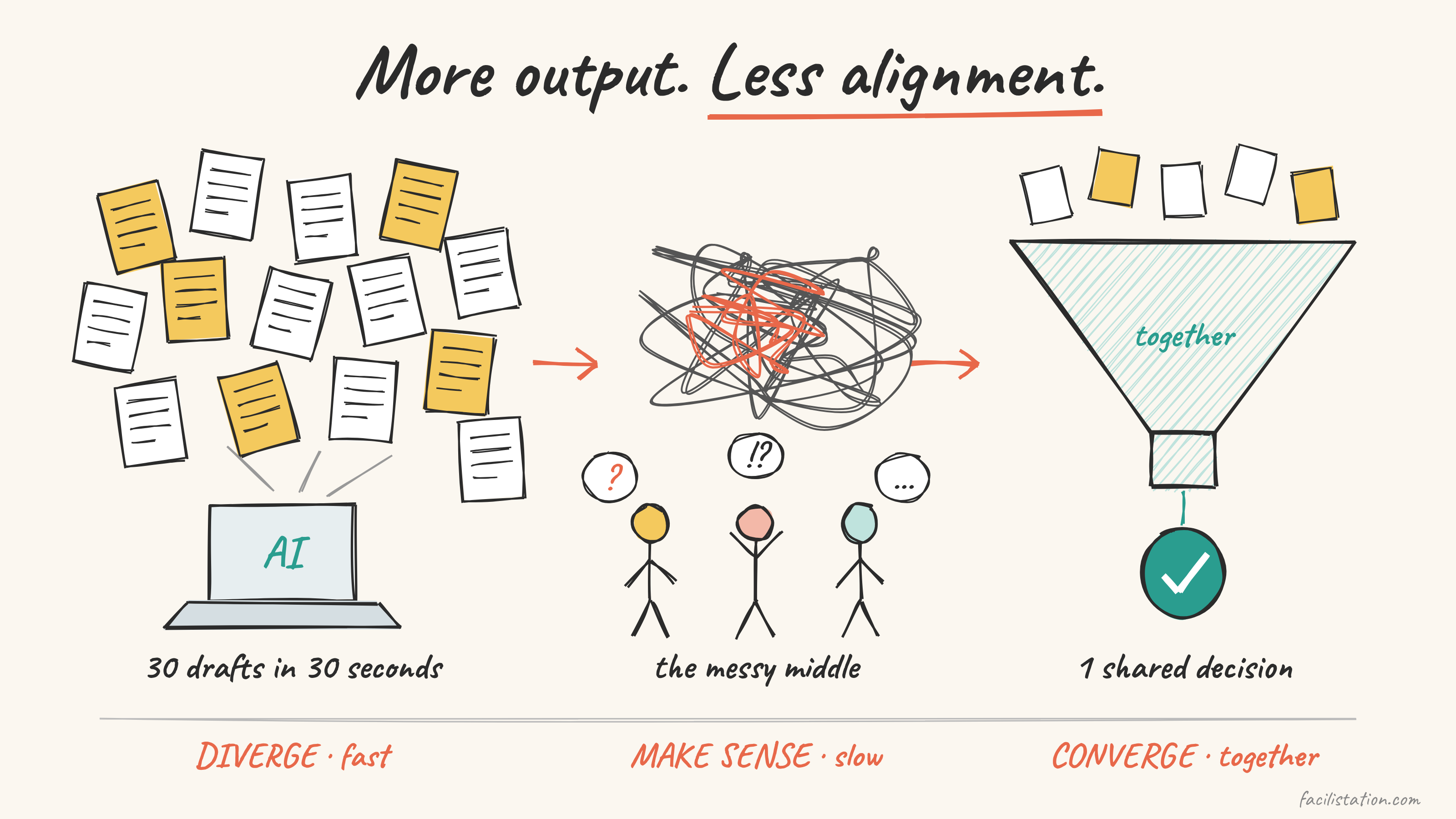
AI has made producing work cheap. Agreeing on it is still expensive.
The bottleneck has moved
For most of my 20 years facilitating workshops, the hard part was getting ideas out of people. Warm-ups, silent brainstorming, “there are no stupid ideas”... you know the drill.
That problem is basically solved. Today anyone can get 20 options in 20 seconds.
So the bottleneck has moved. It’s no longer about making things. It’s about making sense of them together. Choosing. Prioritizing. Committing.
And honestly? Most teams are not trained for that. They’re used to the idea that more input means a better result. With AI, more input often just means more noise.
5 ways AI quietly breaks alignment
I see these patterns again and again, in workshops and in my day-to-day work:
1. Option overload.
When you have three ideas, you discuss them. When you have thirty, you freeze. Too many good options can be worse than too few.
2. Thinking in private.
Before, we thought out loud together, often badly but together. Now everyone thinks alone with their AI and shows up with conclusions. The shared understanding that used to form in the messy middle never gets built.
3. False confidence.
An AI draft looks finished. Nice headings, perfect grammar. So people get attached to it much earlier than they would to a rough sketch on a napkin. And attached people don’t listen. They defend.
4. Different speeds.
Some people on the team are flying with AI. Others are still figuring it out. That gap creates friction nobody talks about, and some people quietly stop contributing.
5. No shared “why”.
Your AI knows the task. It doesn’t know your team’s history, your values, the thing that went wrong last year that nobody wants to repeat. Only the people in the room know that.
This is not a tech problem
I want to be clear: I LOVE using AI. I wrote about it a couple of weeks ago in How to Use AI as Your Co-Facilitator. I use it every single week.
But tools speed up individuals. Alignment only happens together.
If you’ve read my post on How to Successfully Design ANY Workshop, you know that every good workshop moves between divergent thinking (opening up), emergent thinking (the messy middle) and convergent thinking (closing down).
AI is a fantastic divergence machine. It’s weak in the messy middle, and it can’t converge for a group. That part is still human work. It’s facilitation work.
5 practices to realign your AI-powered team
Here’s what I’ve started doing with teams, and what I’d recommend you try:
1. Name the decision before anyone opens a chat window.
Agree on the question first. “What are we deciding today, and what is not on the table?” Sounds basic. Almost nobody does it.
2. Ask AI for options, but make the choice as people.
Use AI to diverge, as much as you like. Then close the laptops. Converge as a group with simple tools: dot voting, an impact/effort matrix, or a short round where everyone says which option they can live with and why.
3. Share your prompts, not just your outputs.
When someone presents an AI draft, ask: “What did you ask it, and why?” The prompt shows the thinking. The output only shows the result.
4. Slow down on purpose.
I know, I know. Everyone wants speed. But a 10-minute sense-making pause can save you three meetings. My favorite is 1-2-4-All: think alone, then in pairs, then in fours, then with the whole group. Simple, and it works every time.
5. Write down the “why”.
Keep a short decision log: what we decided, why, and what we chose not to do. Your team can come back to it. Bonus: you can feed it to your AI tools, so they start with your context instead of a generic one.
Try this: a 45-minute Alignment Reset
If your team feels busy but stuck, try this next week:
Check-in (5 min): One word: how aligned do we feel right now?
What we have (10 min): Lay all the drafts and ideas on the table. No pitching, just showing.
What matters (10 min): What criteria will we use to choose? Agree on these before looking at the options again.
Converge (15 min): Score the options against the criteria. Discuss the gaps, not the favorites.
Commit (5 min): What did we decide, who owns it, when do we check back?
The leader’s job is changing
If you lead a team today, your job is quietly shifting. It’s less about directing the work and more about designing how your team thinks together.
The faster your team moves, the more deliberate your alignment needs to be.
AI won’t do that part for you. And that’s good news, because it’s exactly where good leaders and good facilitators make the difference.
Over to you: When did your team last spend more time aligning than producing? Hit reply or leave a comment. I read every single one ❤️
And if you know a manager whose team is drowning in AI drafts, forward this to them. They’ll thank you.
See you next Friday,
Jose
I hope this post, made sense and you found it useful.
If “HELL YEAH!”, please like it and share it in social media so more people can get can also benefit from it :-)
I would also appreciate if you subscribe, and give some comments here if you wonder something and want to give me some feedback. I would love to read your input here!
If you have a Substack yourself and like my content, I would love for you to recommend “Facili-station” to your subscribers.
Have a nice one!!
Looking for a coach?
In service of those who serve others.
Leadership is hard. Whether you’re stepping into management, leading an entire organization or wondering about your career, the challenges are real: confusing, overwhelming, and sometimes isolating.
I offer a tailored 1:1 or team coaching quarterly program to help you move forward with clarity and confidence. I’ve walked in your shoes, and I’ll work with you to build the resilience and relational skills needed to lead well, beyond just the work.
If this sounds like what you need, let’s talk. Email me at jose@facilistation.com to book a no-strings attached, no-obligation call to talk about your needs and see what I can offer that will fit you the best. Because coaching isn’t expensive. Staying stuck is.
You should see the cost of a life and work that you don’t love... sometimes one good conversation can change your life and your career forever.

Looking for a facilitator and workshop designer?
If you need a workshop designer and facilitator to help you or your team to solve challenges, find solutions, make decisions, and to be more effective an perform better and faster, or a trainer to teach your team on how do this, please contact me at jose@facilistation.com
My workshops are designed to provide the structure required to quickly align and move forward with a plan or idea so you can reclaim time, energy and headspace.