

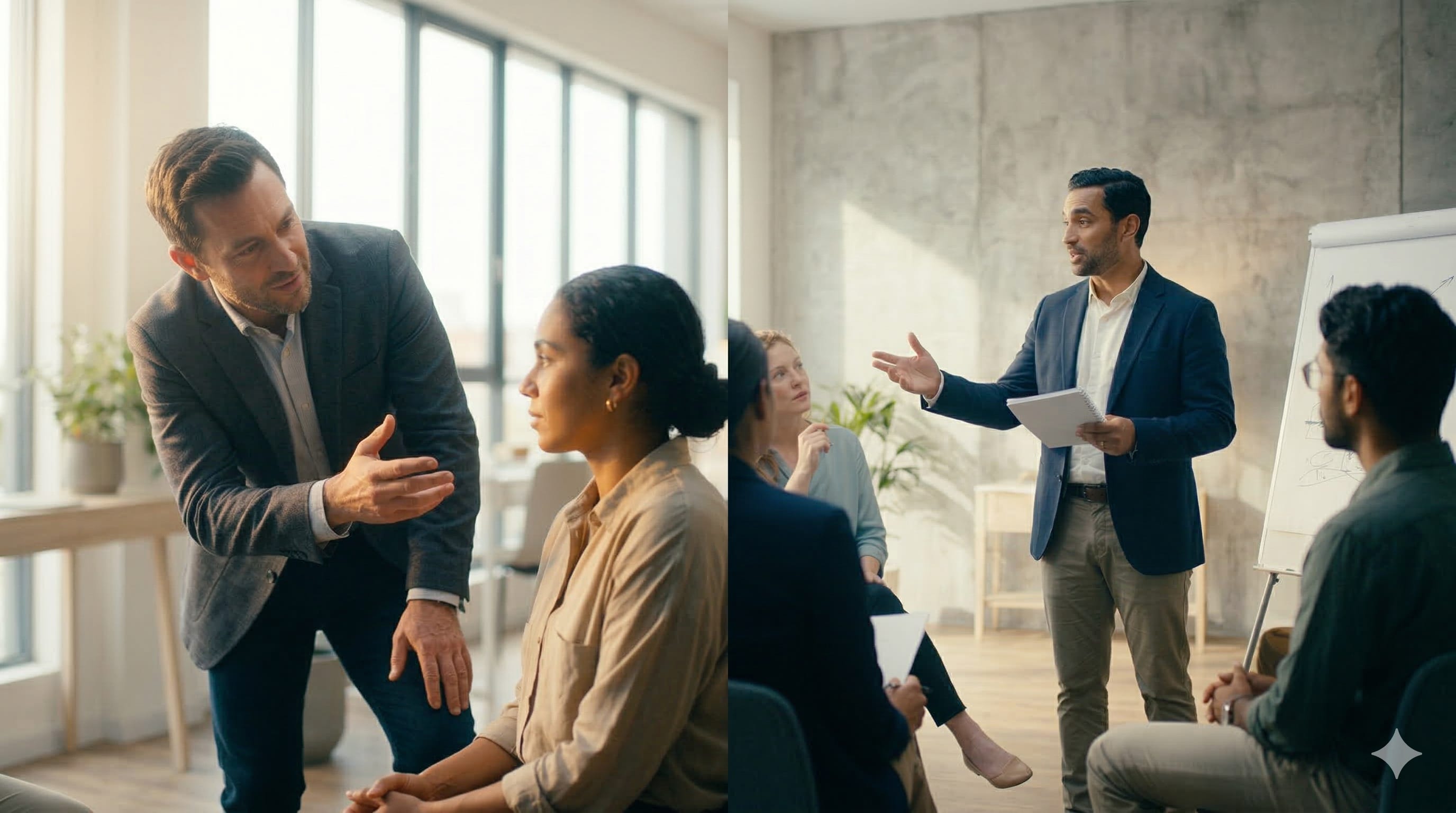
In coaching, a coach supports one person — the coachee — in gaining clarity, insight, and forward movement.
In facilitation, the same thing happens.
The only difference is that the coachee is a group of people.
At their core, coaching and facilitation share the same philosophy:
The answers do not live with the expert. They live with the people in the system.
The role of the coach — or facilitator — is to create the conditions where those answers can emerge.
The Shared Foundation
Both coaching and facilitation are built on a profound shift in leadership thinking.
Instead of telling people what to do, the practitioner helps people think better.
This approach draws from decades of research in coaching psychology, organizational learning, and collective intelligence.
Two foundational ideas are particularly relevant:
People are more committed to solutions they help create.
Groups can think better together when the right conditions are present.
Both coaching and facilitation are practices designed to unlock those conditions.
Coaching: Supporting One Mind
In coaching, the process focuses on an individual.
The coach:
Asks powerful questions
Listens deeply
Reflects patterns and insights
Helps the person see new possibilities
This approach is strongly influenced by Edgar Schein’s concept of Humble Inquiry, which suggests that meaningful change begins when leaders shift from giving advice to asking genuine questions.
In this model, the coach does not provide answers.
Instead, the coach helps the coachee access their own insight and clarity.
As coaching pioneer John Whitmore, author of Coaching for Performance, famously wrote:
“Coaching is unlocking people’s potential to maximize their own performance.”
The key word here is unlocking.
The wisdom already exists in the individual.
The coach helps reveal it.
Facilitation: Supporting Many Minds
Facilitation works in the same way — but at a different scale.
Instead of helping one person think better, the facilitator helps a group think better together.
The facilitator:
Designs the thinking process
Structures the conversation
Creates psychological safety
Encourages equal participation
Surfaces different perspectives
Here, the group becomes the coachee.
The facilitator is essentially coaching the collective intelligence of the room.
Research on Collective Intelligence
This idea is supported by research on collective intelligence.
A landmark study by Anita Woolley and Thomas Malone at MIT found that groups possess a measurable collective intelligence factor — often called the “c-factor.”
Interestingly, the research showed that group performance was not driven by the smartest person in the room.
Instead, it depended on factors such as:
Social sensitivity
Equal participation in conversations
Psychological safety
These are precisely the conditions that facilitators and coaches help create.
When a facilitator structures a conversation well, they are not just managing time or activities.
They are increasing the intelligence of the group.
Psychological Safety: The Hidden Ingredient
Another important research stream comes from Amy Edmondson’s work on psychological safety at Harvard Business School.
Her research shows that teams perform better when people feel safe to:
Speak up
Share ideas
Admit uncertainty
Challenge assumptions
Coaches create this safety for individuals.
Facilitators create it for groups.
Without psychological safety, both coaching conversations and facilitated workshops fail to unlock deeper thinking.
Real Examples: Coaching vs Facilitation in Practice
To make the connection clearer, here are a few real-world examples.
Example 1: A Leader Coaching an Employee
A manager notices that one of their team members feels stuck in their role.
Instead of giving advice, the manager asks questions like:
What part of your work energizes you the most?
What would success look like for you in six months?
What options do you see?
Through this conversation, the employee realizes they want to take on more responsibility in a new area.
The insight did not come from the manager.
It emerged from the employee’s own thinking.
This is coaching.
Example 2: A Facilitated Strategy Workshop
A leadership team needs to decide on strategic priorities for the next year.
Instead of presenting a finished strategy, a facilitator designs a process where leaders:
Individually reflect on emerging trends.
Share perspectives in small groups.
Cluster themes together.
Debate priorities openly.
Converge on a shared direction.
The facilitator does not define the strategy.
They design the thinking process that allows the group to discover it together.
This is facilitation.
Example 3: Improving Meetings Through Facilitation
A department complains that their meetings are ineffective.
Instead of telling them how meetings should work, a facilitator asks the team questions like:
What decisions actually need to happen in meetings?
What information do you need from each other?
Which meetings create value and which ones waste time?
Through structured exercises, the team redesigns their entire meeting structure.
The facilitator did not impose the solution.
The team co-created it.
Example 4: Innovation Workshops
In innovation work, facilitators often run design thinking workshops.
Participants might explore a challenge by:
Mapping user needs
Generating ideas
Prototyping solutions
Testing assumptions
The facilitator does not invent the ideas.
Instead, they create the environment where participants generate better ideas together.
This is collective coaching in action.
The Real Skill Is Not Answers — It Is Process
Both coaching and facilitation are often misunderstood.
Many people assume the value lies in expertise or advice.
But the real skill lies somewhere else.
It lies in process design and presence.
Great coaches and facilitators know how to:
Ask the right questions
Hold space for reflection
Surface assumptions
Guide conversations without dominating them
Help people discover insight themselves
They are not solving the problem.
They are helping others become capable of solving it.
From Individual Insight to Collective Intelligence
Where coaching unlocks individual insight, facilitation unlocks collective intelligence.
This distinction matters enormously in organizations.
Most complex challenges today cannot be solved by a single expert or leader.
They require:
Multiple perspectives
Shared understanding
Alignment
Ownership
Facilitation helps groups move from fragmented thinking to shared clarity.
It transforms meetings into thinking environments.
The Facilitator as a Group Coach
Seen through this lens, facilitation becomes easier to understand.
A facilitator is essentially a group coach.
Someone who helps a team:
Clarify what really matters
See blind spots
Align around priorities
Make better decisions together
Instead of coaching one mind, they are coaching the intelligence of the system.
Why This Matters for Leaders
Modern leadership increasingly requires facilitation skills.
In complex environments, leaders cannot rely solely on authority or expertise.
Instead, they must enable the intelligence of the people around them.
Leadership today is increasingly about:
Asking better questions
Creating space for thinking
Structuring productive conversations
Aligning people around shared understanding
In other words:
The best leaders are often the best facilitators.
A Simple Way to Think About It
You can summarize the relationship like this:
Coaching = Facilitating the thinking of one person
Facilitation = Coaching the thinking of a group
Different scale.
Same philosophy.
Same intention.
Same impact.
References and Influences
This perspective draws on several influential research streams:
John Whitmore — Coaching for Performance
Edgar Schein — Humble Inquiry
Amy Edmondson — Psychological Safety research
Anita Woolley & Thomas Malone (MIT) — Collective Intelligence research
David Clutterbuck — Team coaching research
Together, their work reinforces a powerful idea:
Better questions and better conversations lead to better thinking — individually and collectively.
Want to Go Deeper?
If you are interested in facilitation, leadership, and collective intelligence, I regularly share ideas, frameworks, and practical tools in my newsletter.
Subscribe to Facili-Station and join a growing community of leaders, facilitators, and change-makers exploring how better conversations create better organizations.

And if your organization wants to strengthen its ability to think, align, and decide better together, feel free to reach out. I’d be happy to help.
I truly enjoy your newsletters, and I appreciated that with this newsletter you did an excellent job providing a clear distinction as well as the connection between. I have worked in both roles in my career and it can sometimes be tricky to help others understand that a facilitator is not a “meeting organizer” and sometimes the coach is not the star player - thank you!