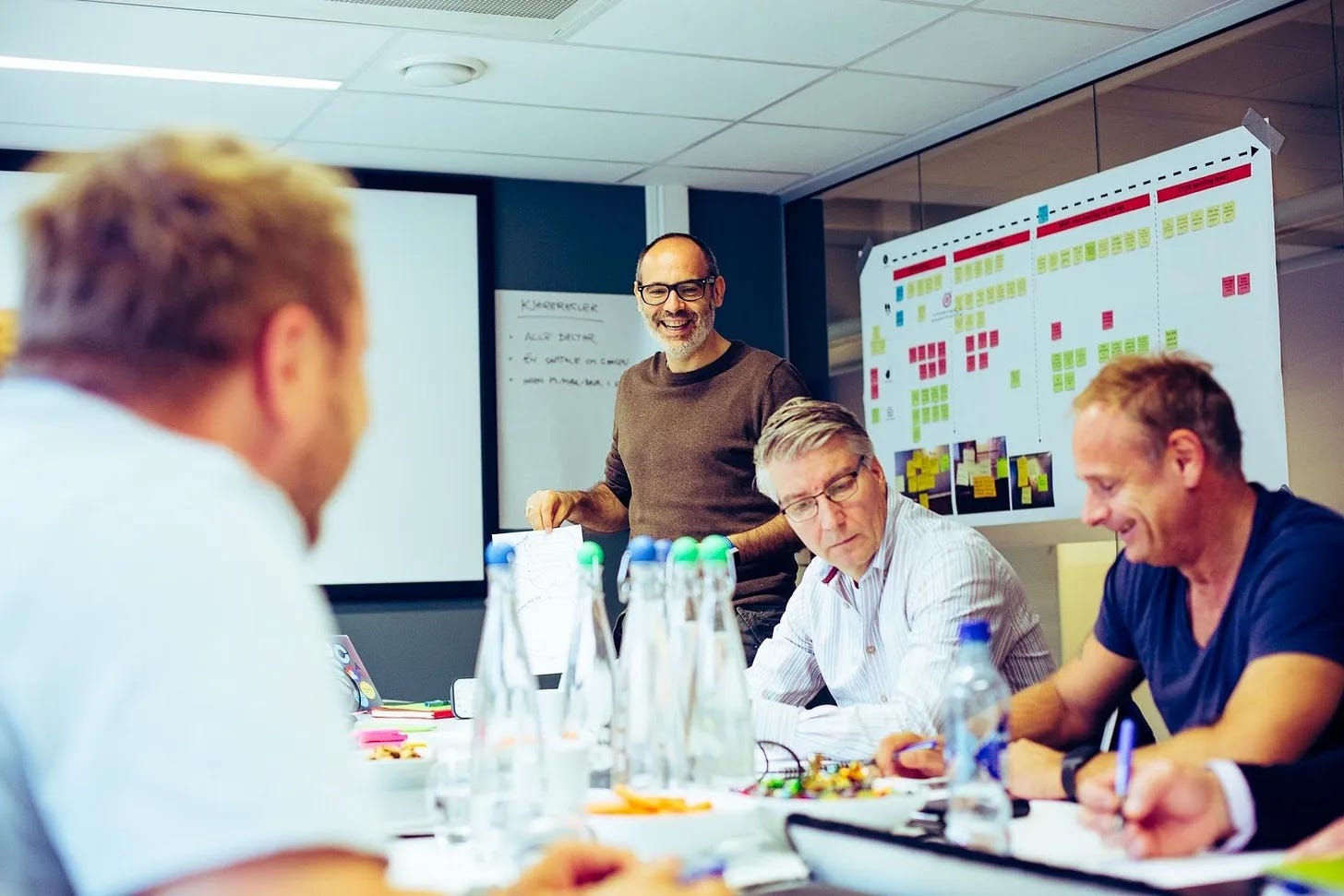
As facilitators, our craft lives and dies in the meetings we hold.
They’re the stage where collaboration happens — or fails. Every agenda we design, every question we pose, every silence we hold shapes whether a meeting becomes a space for meaning or just another calendar slot to survive.
We’ve all been there — those meetings that make you quietly question your life choices. You join because it’s in your calendar, not because you expect anything meaningful to happen. Forty-five minutes later, you leave with less energy, more confusion, and a vague sense that you’ve been robbed of time you’ll never get back.
Why do we keep doing this to ourselves?
The truth is: meetings are not the problem — badly designed meetings are.
When done well, meetings can align, inspire, and create clarity. When done poorly, they drain attention, motivation, and trust.
Let’s look at what separates the two.
Bad Meetings Feel Like This
No clear purpose. You don’t know why you’re there. The conversation drifts, and nothing gets decided.
The wrong crowd. Too many people… or missing the ones who matter.
Dominated by a few voices. The loudest wins, while good ideas die silently.
Low energy and participation. People multitask, turn cameras off, or hide behind their coffee mugs.
Information overload. Endless slides and updates that could’ve been an email.
No closure. You end with “let’s circle back” — but never do.
In short: no focus, no flow, no follow-through.
Good Meetings Feel Like This
Clear purpose and outcomes. Everyone knows why you’re there and what you’re aiming for.
Right people, right size. Small enough to talk, diverse enough to think.
Skilled facilitation. Someone is guiding the flow, balancing voices, and keeping time sacred.
Psychological safety. People dare to disagree, ask questions, and build on each other’s ideas.
Energy and engagement. Visuals, stories, whiteboards, or simple pauses keep minds awake.
Decisions and accountability. Clear next steps, owners, and deadlines before anyone leaves.
Respect for time. Starts and ends on time — and everyone feels it was worth it.
In short: clarity, contribution, and commitment.
The “4-Question Rule” Before Every Meeting
Ask yourself:
Why are we meeting?
Who really needs to be there?
What outcome do we want?
How will we know it was worth it?
If you can’t answer these four, maybe — just maybe — you don’t need a meeting at all.
The Facilitator’s Edge
As facilitators, we hold the power to transform meetings from time sinks into sense-making spaces.
It’s not about fancy tools — it’s about intention, attention, and design.
Bad meetings happen by default.
Good meetings happen by design.
And great meetings?
They happen when we design for meaning.
How to Design a Good Meeting
If you want to move from “we always meet” to “we meet with purpose,” here are some practical steps to design better meetings:
1. Start with purpose, not format.
Ask: What needs to happen that requires people to be together? Decision? Alignment? Ideation? Relationship-building?
Your purpose determines the shape, length, and format of the meeting.
2. Define the outcome.
Imagine the sentence you want to complete at the end: “By the end of this meeting, we will have…”
This sets direction and helps everyone focus.
3. Design the flow.
Think in phases: opening (set tone and purpose), exploration (generate ideas or insights), and closing (make sense and decide).
Use time blocks and transitions intentionally.
4. Choose the right methods.
Select facilitation techniques that fit the purpose — from silent reflection to breakout groups or decision matrices. Don’t just talk; structure interaction.
5. Create psychological safety.
Set norms upfront: curiosity over judgment, building on each other’s ideas, and time for reflection.
6. Prepare your space.
Whether physical or virtual, design for focus and engagement: good lighting, visuals, tools ready, and fewer distractions.
7. End well.
Close with clarity. Review key insights, decisions, and next steps. Confirm who owns what and by when.
8. Reflect and iterate.
After the meeting, ask: What worked? What didn’t? What should we change next time?
Continuous reflection builds meeting culture.
What a Good Meeting Agenda Looks Like
A good agenda is more than a list of topics — it’s a shared map of purpose, flow, and outcomes.
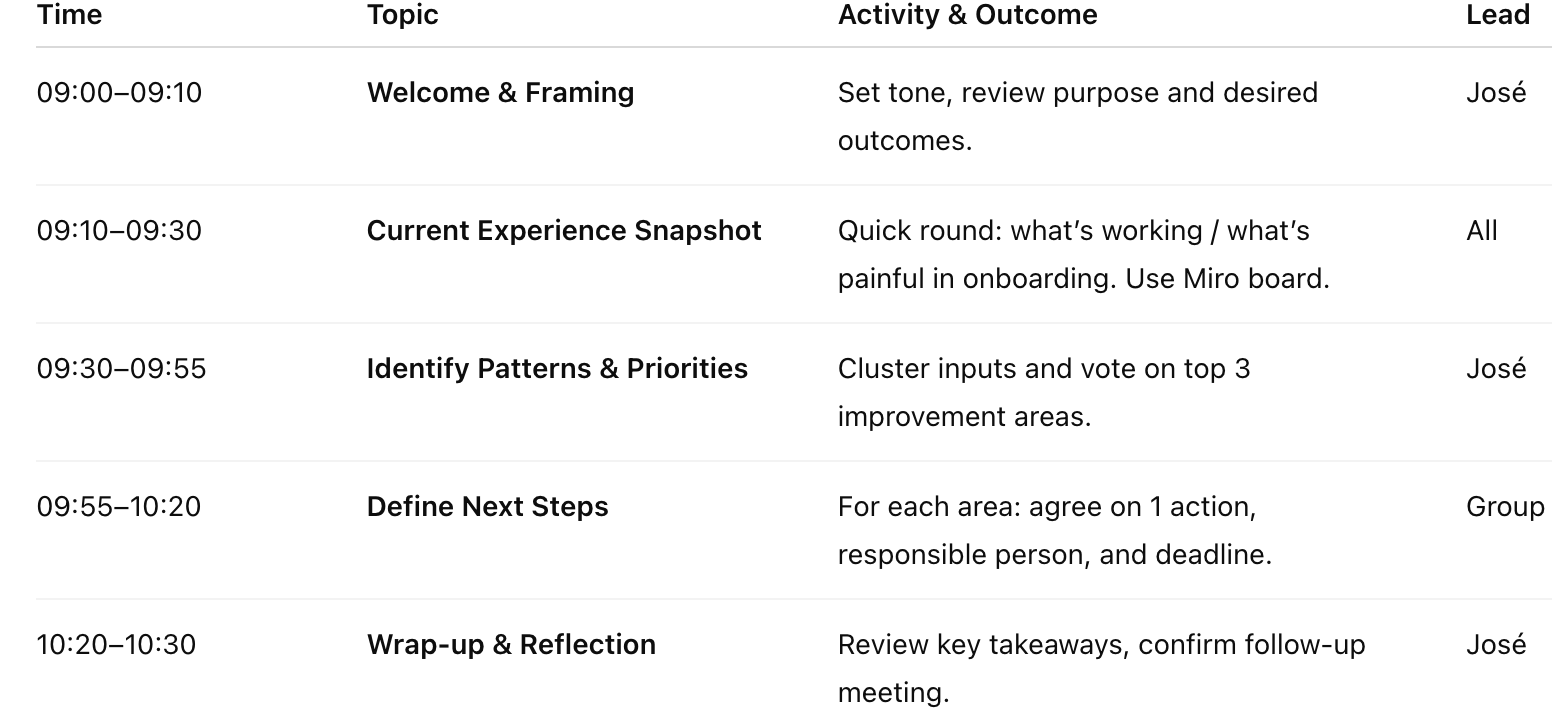
Here’s an example of what a well-designed agenda could look like:
Meeting Title: Redesigning our Onboarding Experience
Date: Tuesday, November 12
Time: 09:00–10:30
Location: Teams / Room 3A
Facilitator: José Redondo
Participants: HR, Service Design, and Team Leads
Purpose:
To align on key pain points in our current onboarding process and define next steps for improvement.
Expected Outcome:
By the end of the meeting, we will have:
A shared understanding of current challenges.
A prioritized list of 2–3 improvement areas.
Clear next steps and owners.
Agenda:
Preparation (Before the Meeting):
Read the onboarding survey results (link attached).
Reflect on one story from your first month at work — what helped or hindered your start?
Follow-up (After the Meeting):
Summary and action tracker shared within 24 hours.
Next check-in: December 3 at 09:00.
A good agenda shows the flow, clarifies responsibilities, and signals intentional design. It tells participants, this time matters.
Try This Next Week
Pick one recurring meeting you attend.
Before the next session, ask yourself (or the organizer) the 4 questions above.
Make one small change — shorten it, change the invite list, or clarify the outcome.
Observe what happens to energy, engagement, and clarity.
Facilitation doesn’t start when the meeting begins — it starts when you design the invitation.
Join the Conversation
If you experiment with redesigning one of your meetings, I’d love to hear how it goes.
What changed? What surprised you? What did you learn about your team?
Share your reflections or your best meeting agenda examples with the Facili-station community.
Together, we can turn meetings from moments of frustration into spaces for alignment, creativity, and connection.
I hope this post, made sense and you found it useful.
If “HELL YEAH!”, please like it and share it in social media so more people can get can also benefit from it :-)
I would also appreciate if you subscribe, and give some comments here if you wonder something and want to give me some feedback. I would love to read your input here!
If you have a Substack yourself and like my content, I would love for you to recommend “Facili-station” to your subscribers.
Have a nice one!!
Looking for a coach?
In service of those who serve others.
Leadership is hard. Whether you’re stepping into management, leading an entire organization or wondering about your career, the challenges are real: confusing, overwhelming, and sometimes isolating.
I offer a tailored 1:1 or team coaching quarterly program to help you move forward with clarity and confidence. I’ve walked in your shoes, and I’ll work with you to build the resilience and relational skills needed to lead well, beyond just the work.
If this sounds like what you need, let’s talk. Email me at jose@facilistation.com to book a no-strings attached, no-obligation call to talk about your needs and see what I can offer that will fit you the best. Because coaching isn’t expensive. Staying stuck is.
You should see the cost of a life and work that you don’t love... sometimes one good conversation can change your life and your career forever.

Looking for a facilitator and workshop designer?
If you need a workshop designer and facilitator to help you or your team to solve challenges, find solutions, make decisions, and to be more effective an perform better and faster, or a trainer to teach your team on how do this, please contact me at jose@facilistation.com
My workshops are designed to provide the structure required to quickly align and move forward with a plan or idea so you can reclaim time, energy and headspace.