

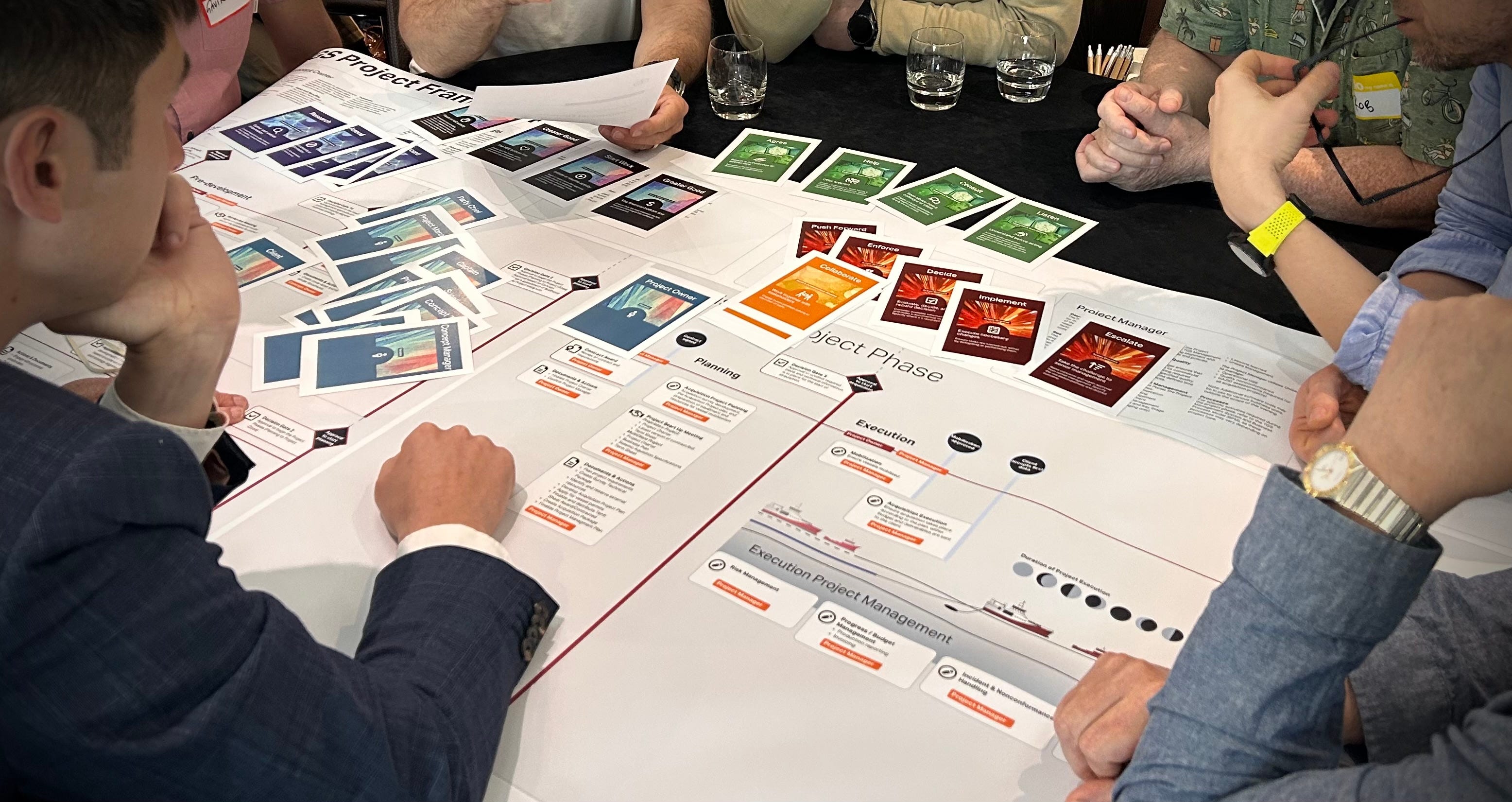
Leaders today are expected to make good decisions in conditions that are anything but simple. They’re asked to adapt, reduce costs, reorganise, adopt new technologies, and lead people through ongoing change. These often happen at the same time, and with little room for error. Teams are capable and motivated, yet progress can feel heavy. Meetings happen. Communication happens. Agreement happens. And still, not so much actually changes.
This isn’t because leaders or teams aren’t trying hard enough. From what I’ve seen, it’s mostly because action is expected before people have had the chance to truly make sense of the situation they’re in.
The hidden problem: acting before understanding
In many organisations, the pressure is to move quickly. Strategies are announced, directions are set, and people are asked to align and execute. What often gets skipped is the work of sense-making.
Different people hold different interpretations of what the problem actually is, what matters most, and what the consequences of certain decisions might be. Even when the same words are used, the mental pictures behind them can be very different.
Agreement on language is mistaken for shared understanding. That’s where friction, rework, and quiet disengagement begin to appear.
What sense-making is
Sense-making is the practice of people helping each other to see a given situation clearly enough to make good decisions and act well. It is not analysis done on behalf of others. It is not consensus-building or “getting everyone on board”. It is not a dictated truth.
Sense-making is about creating the conditions for people to think together. So they can surface assumptions, explore cause and effect, and build a shared picture of what’s really going on. Sense-making is what needs to happen before good decisions are possible.
Brainstorming, creative thinking, imagining futures, and finding solutions together are natural next steps. After sense-making, creative effort is grounded in a shared understanding of the situation. When people are clear on what they are responding to, creativity becomes far more focused, relevant, and effective.
Without that shared understanding, even the most energetic ideation sessions risk producing ideas that solve different problems (or the wrong problems entirely).
Why sense-making matters for leadership and teams
When leaders and teams take the time to make sense of a situation together, a few things reliably change:
Decisions improve, because they’re grounded in a fuller understanding of reality
Progress speeds up, because there’s less rework and fewer reversals
Ownership increases, because people understand why decisions are being made, not just what they’re being asked to do
Team dynamics improve, because curiosity and empathy replaces blame and fear
Importantly, this doesn’t mean slowing everything down. In fact, many leaders find that a relatively small investment in sense-making removes a great deal of hidden friction down the line.
What sense-making looks like in practice
In leadership and team development contexts, sense-making looks different from many familiar approaches.
Instead of presenting solutions, leaders and facilitators help teams explore the situation itself. Different perspectives are made visible across roles, disciplines, personalities, and levels of seniority. Tensions and constraints are named rather than smoothed over. Uncertainty is acknowledged instead of hidden.
Visual tools often play an important role here, not as decoration, but as thinking aids. When complexity is made visible, people can reason about it together more effectively than through conversation alone.
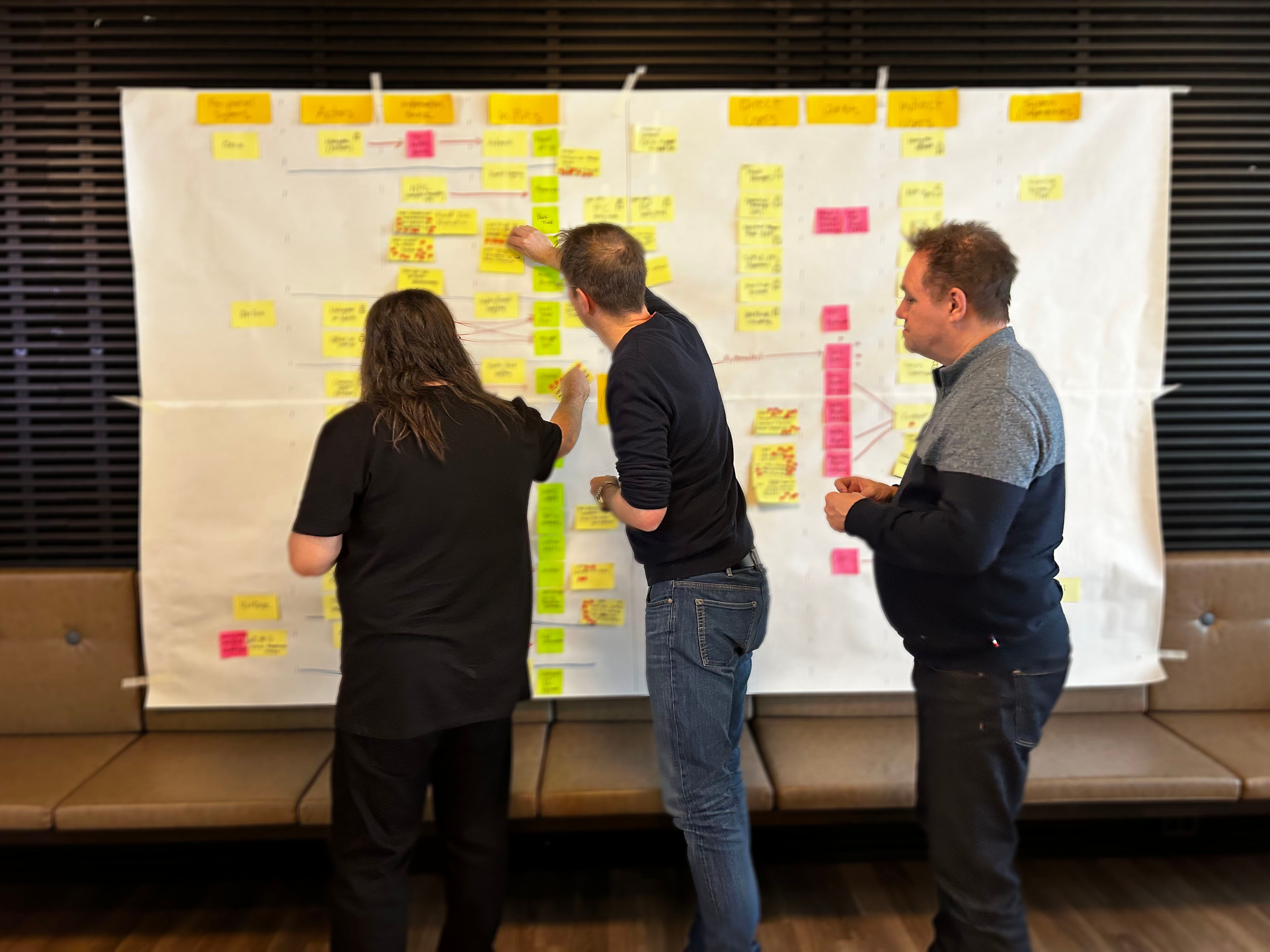
The result is not perfect clarity or total agreement. It is something more practical: a shared enough understanding that people can make sound decisions and take responsibility for them.
Sense-making as a leadership stance
Sense-making is often associated with design or facilitation, and while my method for it is grounded in those aspects, this is a leadership stance.
Leaders are already shaping systems every day. Through the decisions they make, the questions they ask, and the signals they send about what matters. Sense-making simply makes what happens more conscious and collective.
Crucially, this doesn’t mean giving up authority. It means grounding authority in understanding rather than instruction. Leaders move from “telling” people what to do, to creating the conditions where people can see the situation clearly and act responsibly.
Why “telling” isn’t enough
Many leaders rely on presentations and directives to communicate change. Others take a more authoritarian approach.
While this can produce short-term compliance, it often comes at a cost. Research highlighted by Harvard Business Review shows that people in high-trust organisations report significantly higher productivity, engagement, and energy, and lower stress. At the same time, low-trust environments slow decision-making and make it harder for people to speak up and contribute.
Fear may produce action, but it rarely produces good judgment.
Sense-making offers a different path: one that treats people not as obstacles to change, but as essential contributors to understanding it.
Making sense before moving forward
From my own experience working with leaders and teams, I’ve seen that change rarely fails because people resist it. It fails because they are asked to act before they’ve had the chance to understand the situation together.
Participatory sense-making doesn’t promise easy answers or quick fixes. What it offers is something longer lasting: understanding that informs behaviour, decisions people can stand behind, and progress that doesn’t rely on fear or force.
For leaders navigating complexity, that can make all the difference.
If this perspective resonates, I explore participatory sense-making as a leadership practice more deeply in my own writing and work.
About the author
Kat Mather is the founder of Design Linking and brings more than 25 years of experience across design, communication, and organisational change, including over a decade working inside global energy organisations.
She works as a leadership partner at the intersection of leadership, collaboration, and design thinking, often stepping in before clarity exists.
Much of her work happens in moments of uncertainty, where decisions haven’t yet been made and pressure is high. Kat is drawn to these moments. She sees uncertainty not as something to avoid, but as a space full of potential, when teams are willing to explore it together.
Her role is to help leaders and teams make sense of complexity and carry that clarity into action.
nailed it. action before sense-making is our default. teams rushing to 'solutions' when they haven't even understood what's actually happening. the gap between talking and truly making sense together is huge.