It started with a drawing
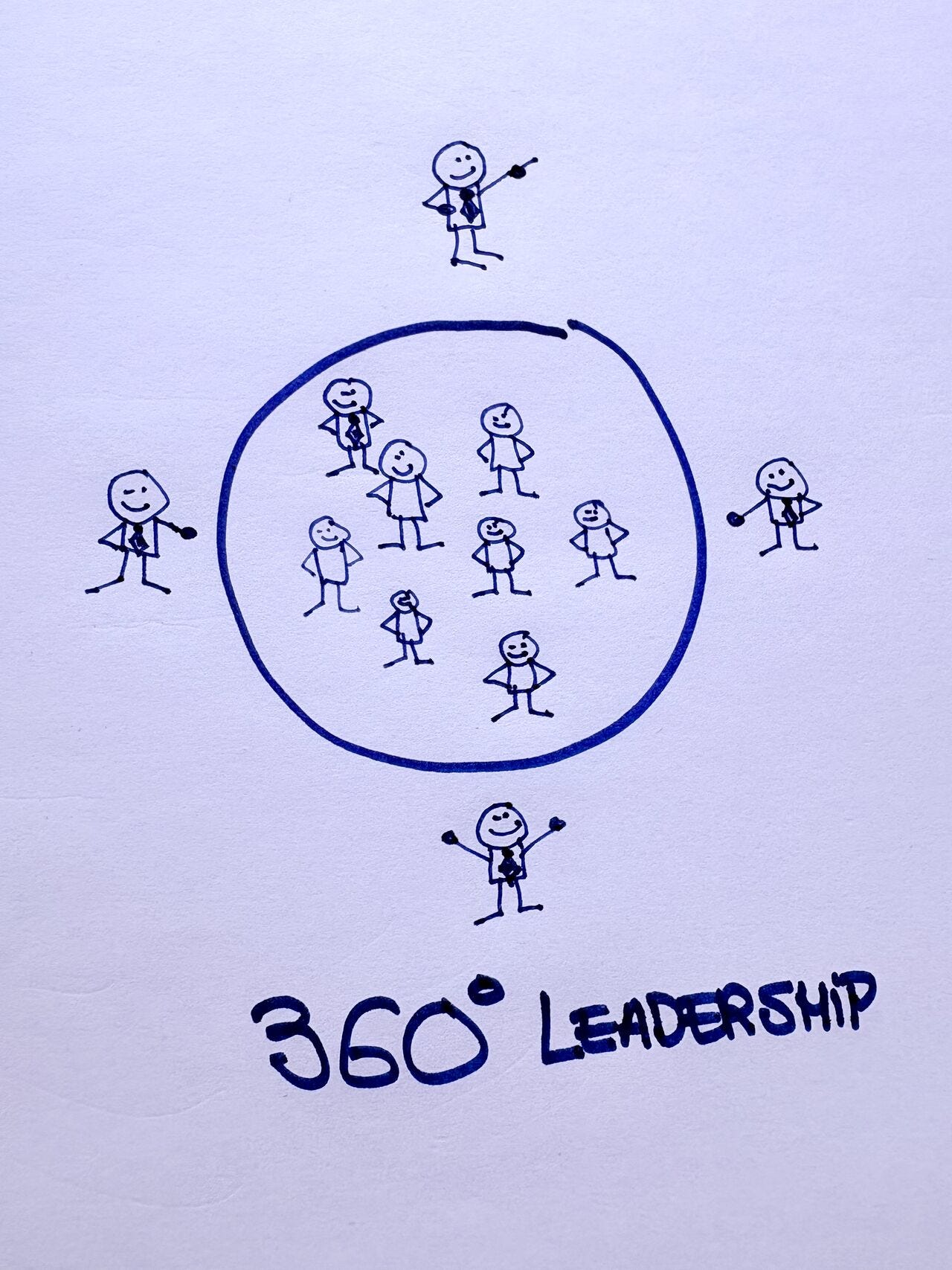
I drew this on a quiet morning with a blue pen and a cup of coffee. A circle full of little people. One figure above it, pointing the way. One on each side, reaching in. One below, arms wide open. And, if you look closely, one more — standing inside the circle, wearing the same tie as the others.
Five figures. One leader.
That is the whole idea.
Most of us grew up with a picture of leadership that has only one figure in it: the one in front. The person on the stage, at the head of the table, at the top of the org chart. We learned that leading means being ahead, being visible, having the answer.
But the teams I have worked with — as a facilitator, as a coach, and as a colleague — have taught me something different. Leadership is not a place you stand. It is a way you move.
I call it 360° Leadership.
Four places to stand
A great leader doesn’t stay in one position. They shift, depending on what the team needs. Look at the drawing again and you’ll find four of them.
In front — you create direction
The figure at the top is pointing. This is the leader who says “this way” when the fog is thick. You show the way and you model the behaviour you want to see. When a team is new, scared or lost, they don’t need a democracy of ideas first. They need someone brave enough to name a direction.
Inside — you build trust
The figure in the circle is easy to miss. Same tie, same height as everyone else. This is the leader who rolls up their sleeves, contributes, and delivers with the team. Trust is rarely built from a podium. It is built when people see you carry the same weight they carry.
By the side — you enable others
The two figures at the edges are reaching in, not pulling out. This is the coach, the sparring partner, the one who removes the stone from the path. You don’t do the work for people. You make it possible for them to do it themselves.
Behind — you create space
The figure at the bottom has arms wide open. Not pushing. Holding. This is the leader who trusts the team to lead, lets others take the credit, and makes sure no one falls behind. It is the quietest position — and often the hardest one for leaders to take.
When a strength becomes a habit
None of these positions is wrong. The usual mistake is staying in just one.
Each position has a shadow, and it shows up the moment a choice turns into a default:
In front: Micromanagement — people wait to be told
Inside: No direction — everyone is busy, nobody is steering
By the side: Dependency — people can’t move without your support
Behind: Chaos — freedom without a shared purpose
We rarely pick our default consciously. We pick it because it feels safe. The expert hides inside the work. The visionary hides in front. The kind coach hides beside. The humble leader hides behind and calls it trust.
I’ve caught myself doing all four. The giveaway is usually a feeling, not a fact: irritation that “nobody takes initiative”, or guilt that “I should be more hands-on”. When I notice that feeling, it is often a sign I’ve been standing in the same spot for too long.
Reading the room
So how do you know where to stand? You listen. Teams are constantly telling us where they need us — just rarely in words.
Step in front when there is confusion, conflicting priorities, or a big change nobody can make sense of yet.
Step inside when the team is overloaded, morale is low, or trust needs repairing.
Step beside when people are capable but stuck, unsure, or growing into something new.
Step behind when the team is ready, energy is high, and your presence would only slow them down.
The same team can need all four in a single week. Monday’s kickoff might need you in front. Wednesday’s crunch, inside. Thursday’s 1:1, beside. Friday’s demo — behind, clapping the loudest.
That’s why I call it 360°. It’s not a ladder you climb. It’s a circle you keep walking around.
A small practice for this week
Leadership is not a position. It’s awareness. And awareness can be trained.
Try this: at the end of each day for one week, take two minutes and jot down where you stood in your most important interaction. Front, inside, side or behind. No judgement — just notice.
At the end of the week, look at your notes and ask yourself:
Which position did I default to most?
Was that what the team needed — or what felt comfortable for me?
Which position do I avoid? What am I afraid would happen if I stood there?
Who on my team might need me somewhere different right now?
You may be surprised. Most leaders I coach discover they are excellent in one or two positions and almost absent in the others. That’s not a failure. It’s a map.
The only question that matters
Go back to the drawing one last time. The circle in the middle is the point. Not the leader. The team.
Every figure around it is the same person asking the same question from a different angle:
“Where does my team need me right now?”
Not where I’m most comfortable. Not where I look most like a leader. Where they need me.
That’s the real question. And the answer will change — tomorrow, next week, next quarter. Good leaders keep asking it.
Now I’m curious: which position do you naturally default to? And which one do you find hardest to take? Share it in the comments — I read every single one.
Have a nice one!
I hope this post, made sense and you found it useful.
If “HELL YEAH!”, please like it and share it in social media so more people can get can also benefit from it :-)
I would also appreciate if you subscribe, and give some comments here if you wonder something and want to give me some feedback. I would love to read your input here!
If you have a Substack yourself and like my content, I would love for you to recommend “Facili-station” to your subscribers.
Have a nice one!!
Looking for a coach?
In service of those who serve others.
Leadership is hard. Whether you’re stepping into management, leading an entire organization or wondering about your career, the challenges are real: confusing, overwhelming, and sometimes isolating.
I offer a tailored 1:1 or team coaching quarterly program to help you move forward with clarity and confidence. I’ve walked in your shoes, and I’ll work with you to build the resilience and relational skills needed to lead well, beyond just the work.
If this sounds like what you need, let’s talk. Email me at jose@facilistation.com to book a no-strings attached, no-obligation call to talk about your needs and see what I can offer that will fit you the best. Because coaching isn’t expensive. Staying stuck is.
You should see the cost of a life and work that you don’t love... sometimes one good conversation can change your life and your career forever.

Looking for a facilitator and workshop designer?
If you need a workshop designer and facilitator to help you or your team to solve challenges, find solutions, make decisions, and to be more effective an perform better and faster, or a trainer to teach your team on how do this, please contact me at jose@facilistation.com
My workshops are designed to provide the structure required to quickly align and move forward with a plan or idea so you can reclaim time, energy and headspace.