The moment every workshop goes quiet
You know the moment. It’s mid-morning, the wall is covered in sticky notes, and nobody can see a pattern. Someone asks, half joking, “So… what are we actually doing here?” The room goes quiet.
Most of us were taught to answer that question with a neat picture: two diamonds, four phases, a clean path from problem to solution. But in that moment, the neat picture feels like a lie. It doesn’t look anything like the mess in the room.
There’s another picture that tells the truth about that moment. It’s a scribble. And the best facilitators I know use both.
The Squiggle: the most honest drawing in design
Around 2002, designer Damien Newman drew a line to explain to clients what they were paying for. It starts as a tangled knot, slowly loosens, and ends as one clean, straight line. Under the knot: research and synthesis. In the middle: concept and prototype. At the end: design.
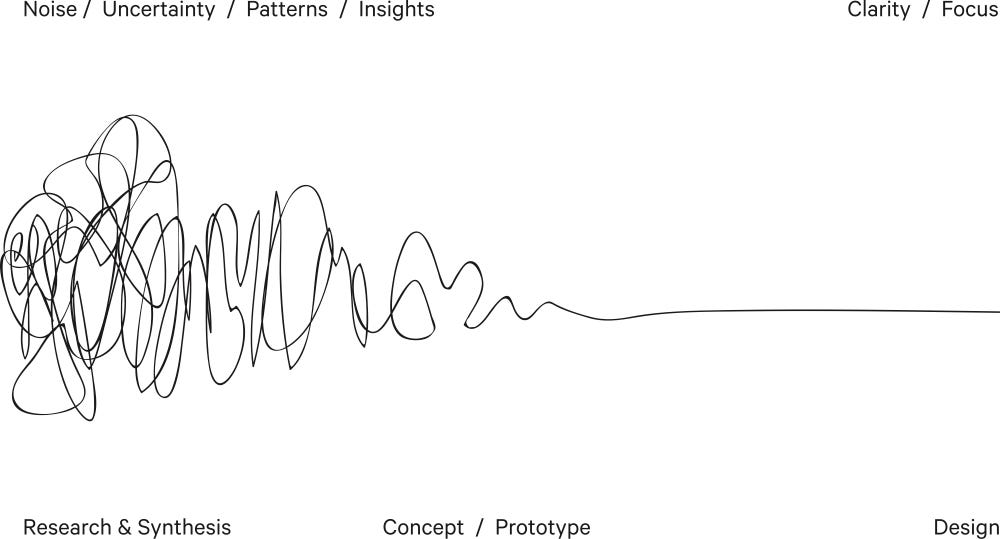
That’s it. No phases, no methods, no toolkit. The Squiggle doesn’t tell you what to do. It tells you how it will feel: confusing at first, then gradually clearer.
Its real power is permission. When a team sees the knot, they stop reading confusion as failure. They start reading it as progress. Newman made it free to use, which is why it shows up in so many kickoff decks.
The Double Diamond: the map everyone knows
In 2004–05, the UK Design Council studied how design teams in large companies actually worked. The result was two diamonds and four phases:
1. Discover: open up. Research, listen, explore the problem.
2. Define: narrow down. Agree on what the real problem is.
3. Develop: open up again. Generate and test many possible solutions.
4. Deliver: narrow down. Build, launch and learn.
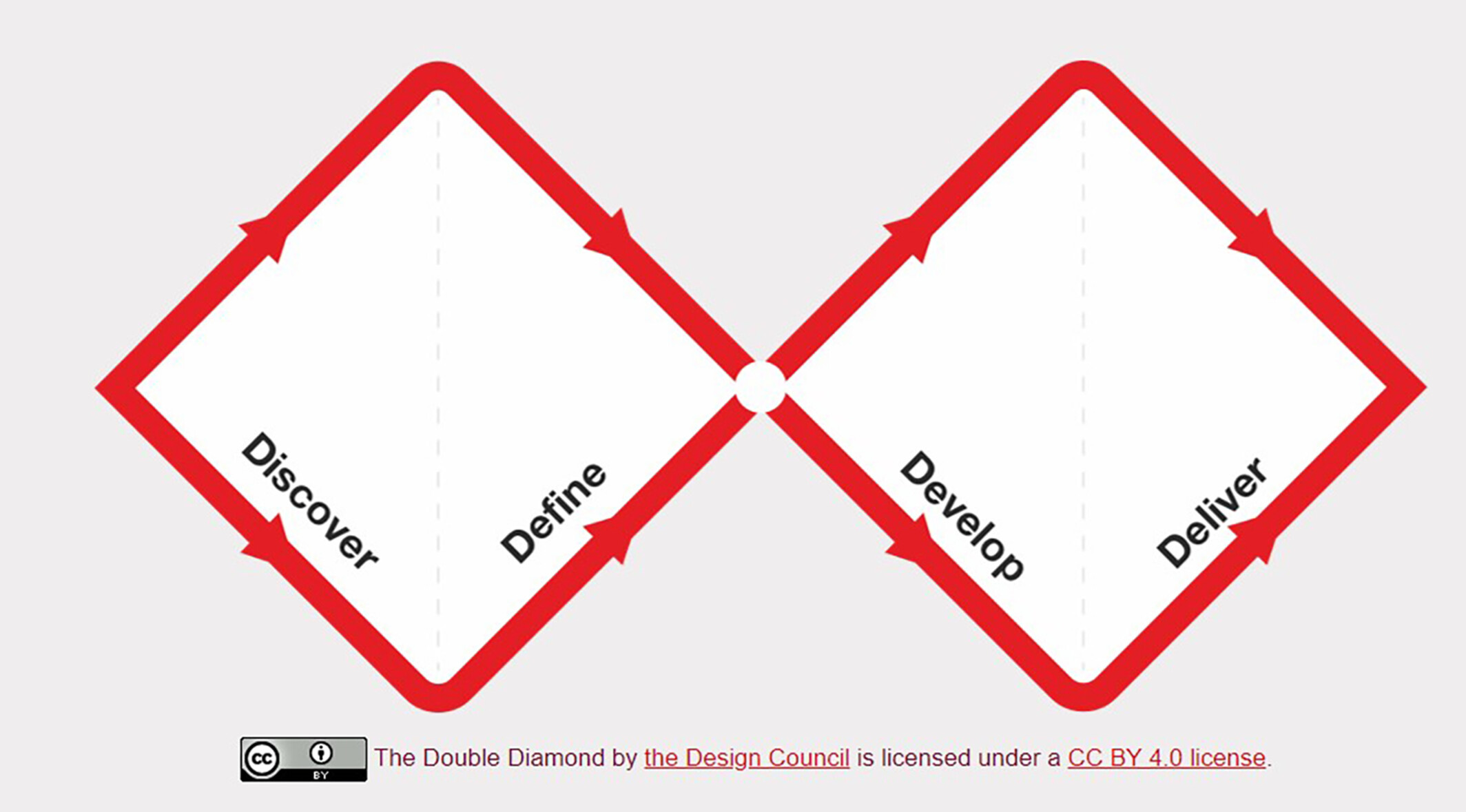
The big idea is the rhythm: diverge, converge, diverge, converge. First make sure you’re solving the right problem. Then make sure you’re solving it the right way.
It gives teams shared language, a planning backbone and a crucial reminder: don’t jump to solutions before you understand the problem. No wonder it’s on every service design wall.
Map vs. weather: where they clash
The Double Diamond is a map. It tells you where you are and what to do next. The Squiggle is a weather report. It tells you how the trip will feel.
Each one hides something the other reveals:
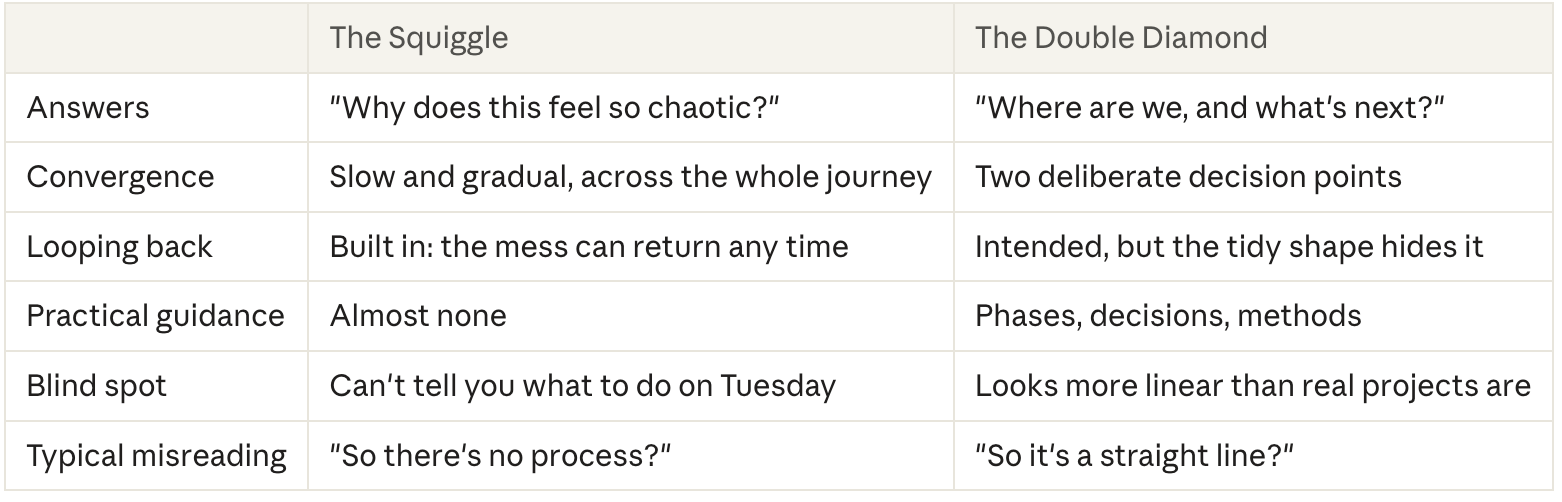
Use only the diamond, and your team will panic when reality doesn’t match the drawing. Use only the squiggle, and nobody knows when the chaos is supposed to end.
Better together: draw the Squiggle inside the Diamond
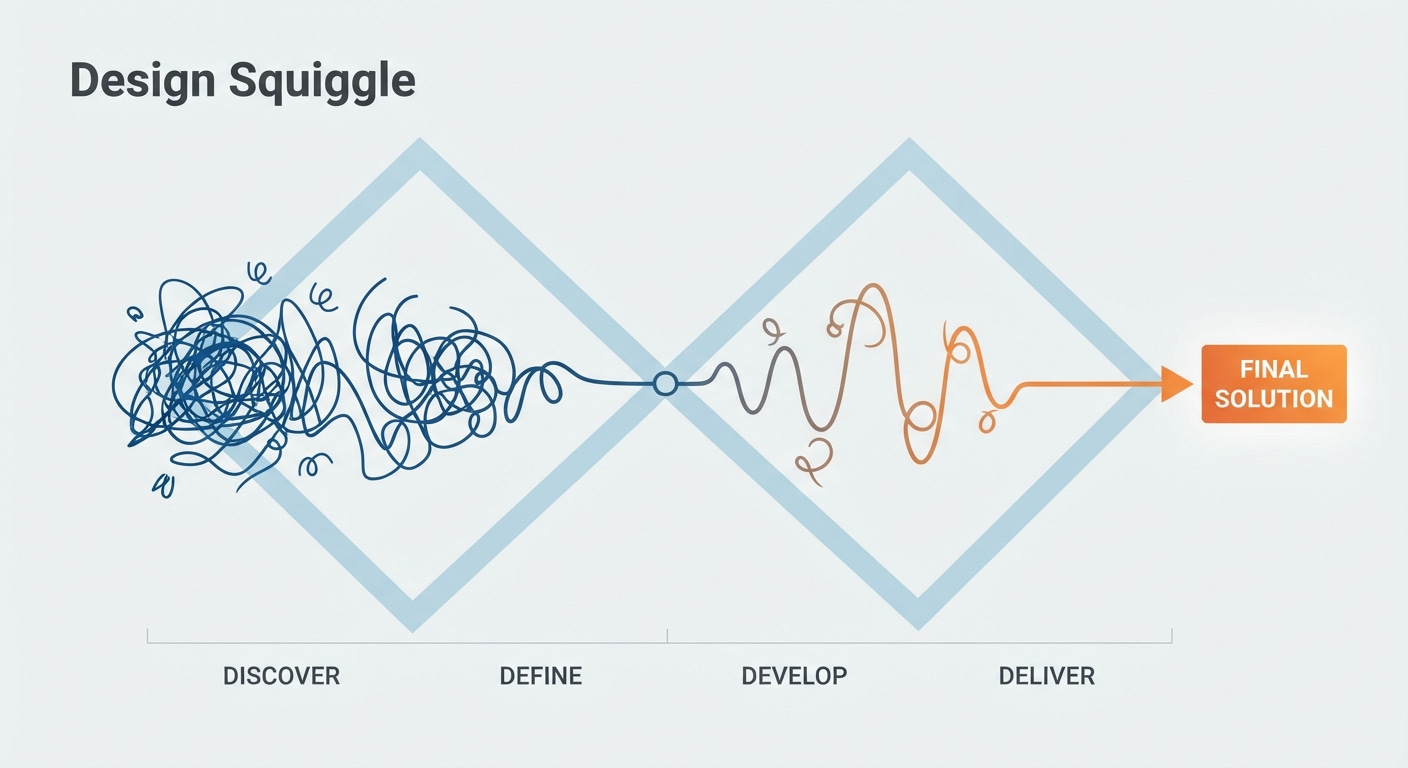
Here’s the trick: stop treating them as rivals. Lay the Squiggle on top of the Diamond. The Diamond becomes the structure; the Squiggle becomes the lived experience inside it.
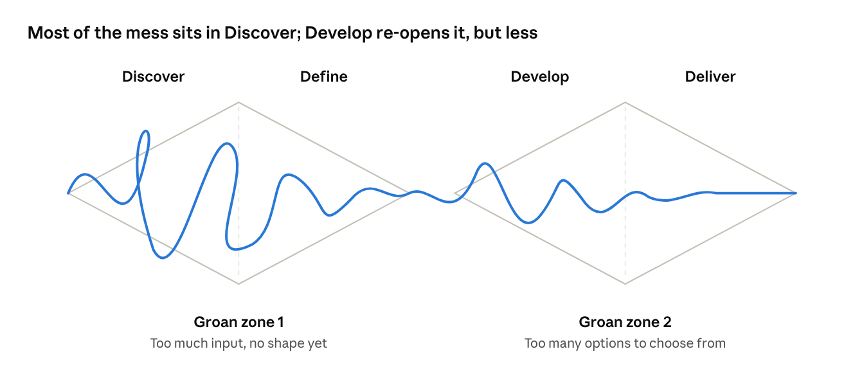
Suddenly the picture tells the truth. Discover is the most disorienting stretch. Define rarely lands as one sharp point. Develop tangles things up again, but with a frame around it, so it feels exploratory instead of lost. And if a prototype reveals you misread the problem, the line knots up and you’re back in the first diamond. That’s not failure. That’s design.
Notice where the friction lands: right at the turn of each diamond, where opening up has to become narrowing down. Facilitators know this as Sam Kaner’s “groan zone”. It’s not a sign the process is broken. It’s the process working.
How to use both in your next workshop
You don’t need a new framework. You need to use the two you already have on purpose.
1. Open with the Squiggle. At kickoff, show the knot and say it out loud: “Around the middle of today, this will feel confusing. That’s by design.” You’ve just pre-empted the panic.
2. Build the agenda on the Diamond. Label every activity as opening up or narrowing down. Never mix both in one exercise; it’s one of the most common reasons sessions stall.
3. Run squiggle check-ins. Ask people to mark where they feel they are on the line. It’s a fast, honest read on whether the group is ready to converge.
4. Plan for the groan zone. Put extra structure, breaks and patience at the turn of each diamond. Expect friction there, and don’t mistake it for failure.
5. Watch for mismatches. In Define but still feeling lost? Don’t force the problem statement. In Discover and already feeling certain? You’ve probably converged on someone’s pet solution.
Stop choosing. Start combining.
The Diamond tells you what to do next. The Squiggle tells you whether your group is ready for it. The magic happens when you hold both at once.
So next time the room goes quiet and someone asks what you’re actually doing, don’t apologise for the mess. Point at the knot and say: “Right here. Exactly where we should be.”
Over to you: which one do you use most, and where has it let you down? Reply or leave a comment.
I hope this post, made sense and you found it useful.
If “HELL YEAH!”, please like it and share it in social media so more people can get can also benefit from it :-)
I would also appreciate if you subscribe, and give some comments here if you wonder something and want to give me some feedback. I would love to read your input here!
If you have a Substack yourself and like my content, I would love for you to recommend “Facili-station” to your subscribers.
Have a nice one!!
Looking for a coach?
In service of those who serve others.
Leadership is hard. Whether you’re stepping into management, leading an entire organization or wondering about your career, the challenges are real: confusing, overwhelming, and sometimes isolating.
I offer a tailored 1:1 or team coaching quarterly program to help you move forward with clarity and confidence. I’ve walked in your shoes, and I’ll work with you to build the resilience and relational skills needed to lead well, beyond just the work.
If this sounds like what you need, let’s talk. Email me at jose@facilistation.com to book a no-strings attached, no-obligation call to talk about your needs and see what I can offer that will fit you the best. Because coaching isn’t expensive. Staying stuck is.
You should see the cost of a life and work that you don’t love... sometimes one good conversation can change your life and your career forever.

Looking for a facilitator and workshop designer?
If you need a workshop designer and facilitator to help you or your team to solve challenges, find solutions, make decisions, and to be more effective an perform better and faster, or a trainer to teach your team on how do this, please contact me at jose@facilistation.com
My workshops are designed to provide the structure required to quickly align and move forward with a plan or idea so you can reclaim time, energy and headspace.