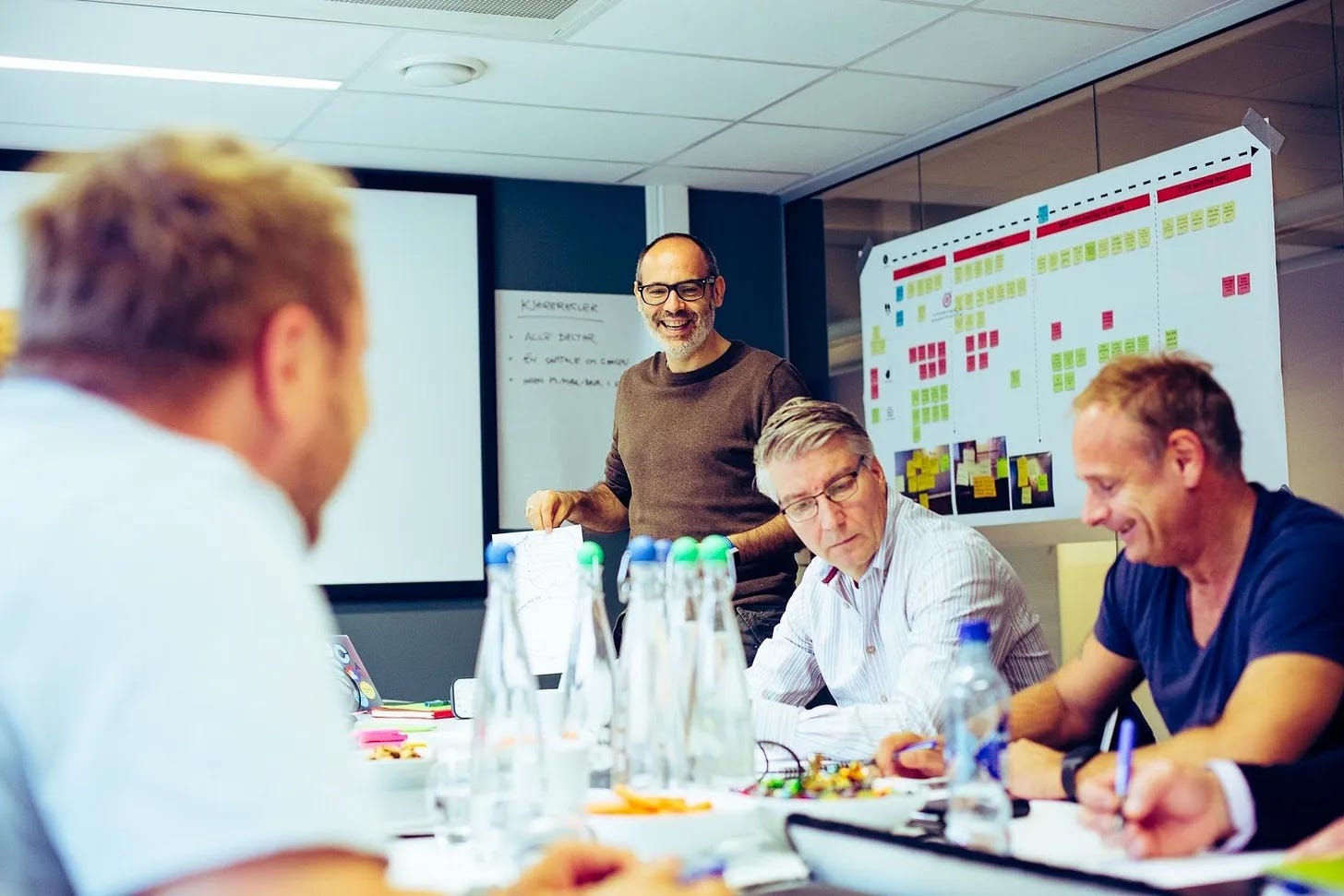
Every workshop or meeting is a micro-cosmos of human behaviour.
You can design the most elegant agenda, the most inspiring exercises, and the most beautiful Miro board, but the mindset people walk in with will shape the entire experience.
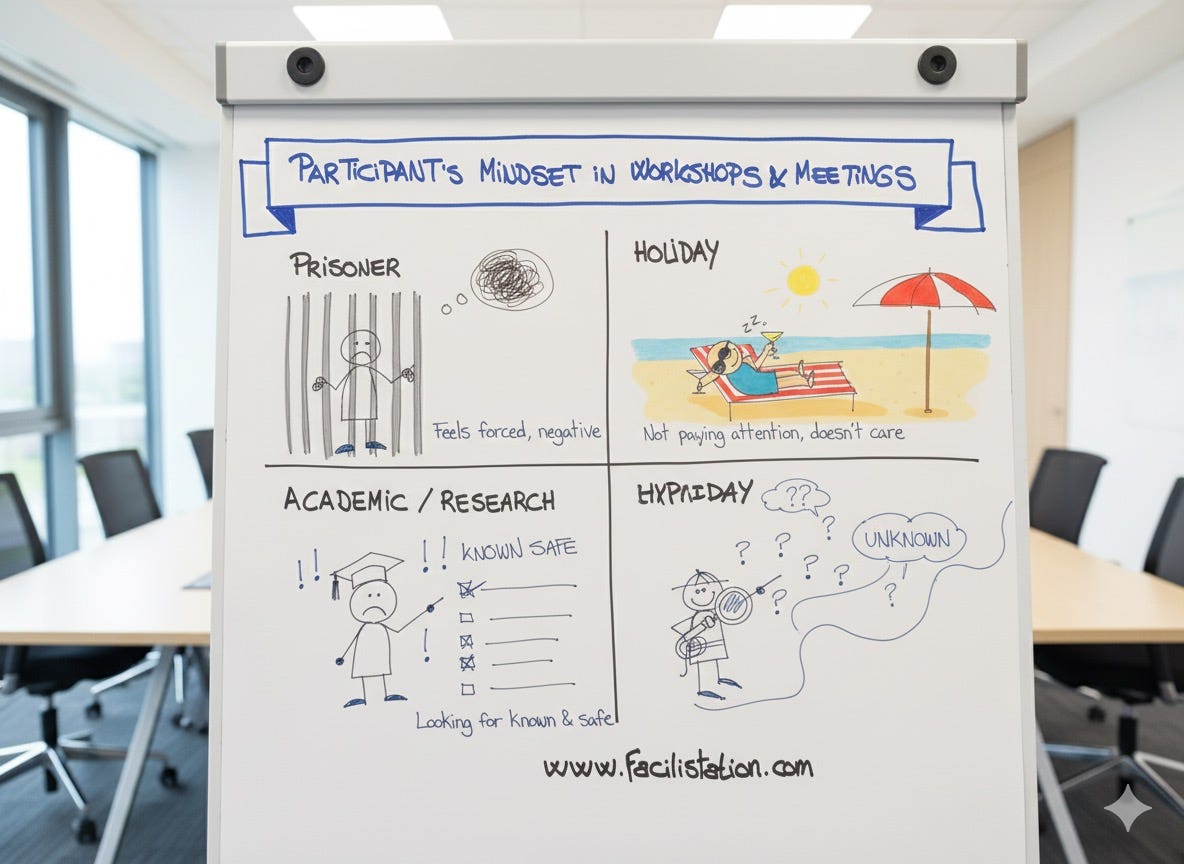
After years designing and facilitating workshops across sectors, I keep noticing the same four mindsets showing up again and again.
Not job titles.
Not personalities.
Just states of mind that dramatically influence how someone participates, or doesn’t.
Let’s walk through them.
1. The Prisoner
“I have to be here, but I don’t want to be.”
You can recognise the Prisoner instantly: arms crossed, minimal participation, quiet resistance. They feel forced into the room by their manager, by a project mandate, by organisational dynamics they don’t control.
Their internal narrative sounds like this:
“This is a waste of time.”
“I have real work to do.”
“Please let this end soon.”
Prisoners aren’t bad people. They’re simply protecting their autonomy.
They don’t feel ownership, agency, or purpose in the session.
Facilitation move: give them choice.
Let them set expectations, raise concerns, and influence the direction. Autonomy is the antidote to resistance. When someone feels they can shape the space, they stop trying to escape it.
2. The Holiday Participant
“I’m here… but not really.”
The Holiday mindset looks relaxed, pleasant and utterly disengaged. They’re physically present, but mentally on a sunbed with a cocktail. They’re not negative; they’re simply not invested.
Their internal narrative:
“I’ll just sit back and see what happens.”
“This doesn’t require anything from me.”
“Other people can do the talking.”
This mindset shows up when people see the session as irrelevant, optional, or “nice to have.”
Facilitation move: make the purpose personal.
Connect the workshop outcomes to something they care about — their role, their daily pain points, or their ambitions. Relevance is the enemy of apathy.
3. The Researcher
“I’m listening… but only for what I already know.”
This participant is engaged, but in a narrow, self-protective way. They’re attentive, analytical, and constantly scanning for confirmation of their existing views.
They stay in the known, the safe, the proven.
Their internal narrative:
“Does this align with what I already believe?”
“Where is the evidence?”
“I trust what I know more than what you’re proposing.”
Researchers contribute, but they rarely stretch. They safeguard certainty.
Facilitation move: legitimise discomfort.
Invite them to test assumptions, not abandon them. Create structured experiments rather than abstract creativity. When exploration feels safe, they expand their range.
4. The Explorer
“Let’s see where this takes us.”
The Explorer is every facilitator’s dream mindset: open, curious, playful, willing to step into the unknown. They embrace uncertainty and move toward new ideas without needing guarantees.
Their internal narrative:
“Interesting… let’s try.”
“What else could be true?”
“Let’s go deeper.”
Explorers raise the collective energy. They help others move, shift, and loosen up. But relying on them alone is not a strategy. They’re the spark, not the entire fire.
Facilitation move: unleash them, but structure the space.
Explorers thrive when you give them room to roam within a clear container. Too much freedom becomes chaos; too little shuts down their creativity.
Why This Matters More Than Methods
Most facilitators obsess about tools, sticky notes, canvases, and activities. But none of this matters if the people in the room are mentally unavailable.
A group of Prisoners will kill even the most elegant workshop design.
A room full of Holiday participants will make any innovation exercise fall flat.
Researchers will analyse a prototype to death without ever building one.
Explorers will take you to magical places, but without structure, also to confusion.
Your real job as a facilitator is not managing activities.
It’s managing mindsets.
The Facilitator’s Challenge and Opportunity
You will always have a mix of all four.
You can’t control who walks into the room.
But you can shift the mindset they operate from.
By building psychological safety.
By giving participants choice and agency.
By creating relevance.
By balancing structure and play.
By making the unknown feel like an adventure rather than a threat.
A great workshop is not about getting everyone to become Explorers.
It’s about meeting people where they are and helping them move one step forward.
And when that happens — when a Prisoner softens, a Holiday participant wakes up, a Researcher experiments, and an Explorer shines — something powerful emerges:
Real collaboration.
Real insight.
Real change.
Looking for a coach?
In service of those who serve others.
Leadership is hard. Whether you’re stepping into management, leading an entire organization or wondering about your career, the challenges are real: confusing, overwhelming, and sometimes isolating.
I offer a tailored 1:1 or team coaching quarterly program to help you move forward with clarity and confidence. I’ve walked in your shoes, and I’ll work with you to build the resilience and relational skills needed to lead well, beyond just the work.
If this sounds like what you need, let’s talk. Email me at jose@facilistation.com to book a no-strings attached, no-obligation call to talk about your needs and see what I can offer that will fit you the best. Because coaching isn’t expensive. Staying stuck is.
You should see the cost of a life and work that you don’t love... sometimes one good conversation can change your life and your career forever.

Looking for a facilitator and workshop designer?
If you need a workshop designer and facilitator to help you or your team to solve challenges, find solutions, make decisions, and to be more effective an perform better and faster, or a trainer to teach your team on how do this, please contact me at jose@facilistation.com
My workshops are designed to provide the structure required to quickly align and move forward with a plan or idea so you can reclaim time, energy and headspace.