You can work with someone for years and still not know something important about them.
A concern they haven’t voiced.
A strength you haven’t noticed.
A behaviour you don’t realise is affecting others.
Or a capability the team has never had the opportunity to discover.
This is the territory of the Johari Window.
What is the Johari Window?
The Johari Window is a simple psychological model for understanding self-awareness, feedback, openness and relationships.
It was developed in 1955 by American psychologists Joseph Luft and Harrington Ingham. The name “Johari” combines parts of their first names: JOseph and Harrington.
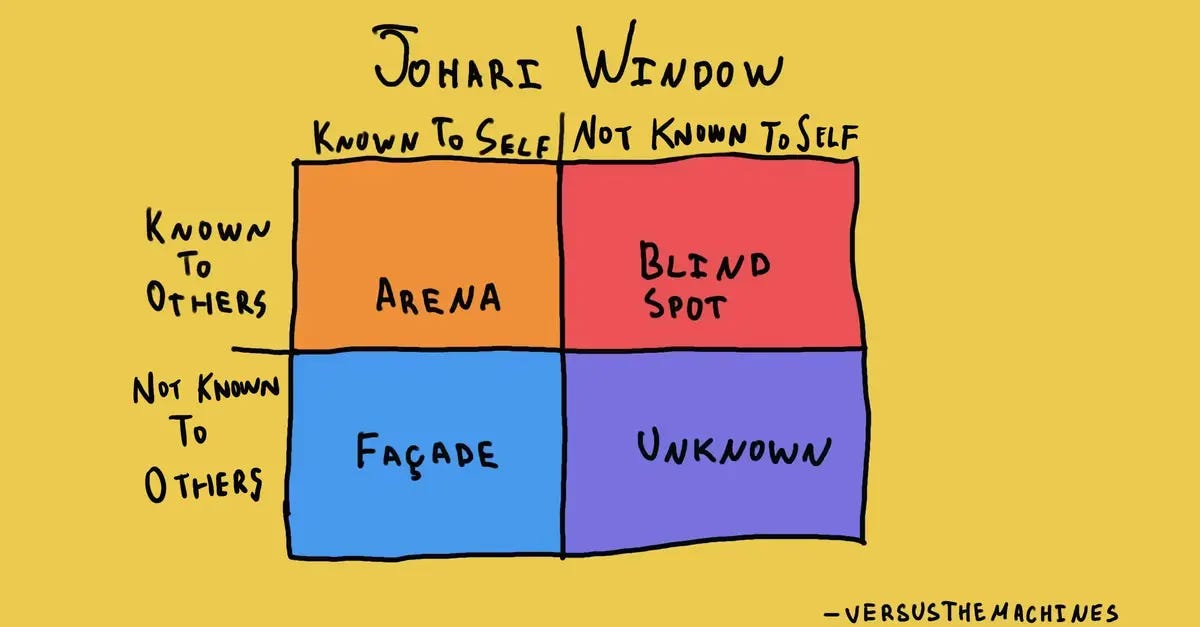
The model explores what we know about ourselves and what others know about us, dividing it into four areas:
Open — what I know about myself and others know.
Blind — what others see in me that I don’t see.
Hidden — what I know but haven’t shared.
Unknown — what neither I nor others know yet.
Four simple boxes.
But behind them is a powerful idea:
We can’t fully understand ourselves or our teams from our own perspective.
Sometimes we need others to help us see.
Sometimes we need the courage to share.
And sometimes we need to experiment to discover what none of us knows yet.
The four areas
1. The Open Area
This is what I know about myself and others know about me.
My role. My strengths. My preferences. How I usually communicate.
When important information is shared, people have less need to guess.
For example:
“I like to think before I respond.”
“I tend to get enthusiastic and move quickly.”
“I prefer people to challenge my thinking.”
These small insights can change how colleagues interpret behaviour.
The Open Area creates shared understanding.
2. The Blind Spot
This is what others see in me that I don’t see myself.
Perhaps I interrupt people when I’m excited.
Perhaps I don’t realise that my silence is interpreted as disagreement.
Perhaps I believe I’m giving people freedom, while they experience me as unavailable.
Blind spots aren’t necessarily weaknesses. They can also contain strengths we haven’t recognised in ourselves.
The challenge is obvious:
If we can’t see the blind spot, we need someone else to point it out.
A useful question is:
“What can you see that I might not be seeing?”
3. The Hidden Area
This is what I know about myself but others don’t know.
Maybe I’m uncertain.
Maybe I disagree.
Maybe I’m worried about something.
Maybe I have an idea but haven’t found the right moment to share it.
Not everything needs to be disclosed. Healthy teams still have boundaries and personal privacy.
The question is whether something important is being kept hidden when making it visible would improve the work.
4. The Unknown
This is what neither I nor others know yet.
You discover it through experience.
Give someone a responsibility they haven’t had before.
Try a different way of working.
Run an experiment.
Bring different disciplines together.
A team may discover a capability it didn’t know it had — or a limitation nobody had anticipated.
Either way, learning has happened.
The Unknown is where experimentation becomes a team-development tool.
Try it with your team: The Johari Conversation
You can turn the model into a simple 30–45 minute team exercise.
Step 1 — Set the context | 5 minutes
Explain the four areas and make one principle explicit:
The purpose isn’t to expose people. It’s to create useful insight for how we work together.
People choose what they want to share.
Step 2 — Individual reflection | 7 minutes
Give everyone a piece of paper divided into four sections, or use a shared digital board.
Ask them to reflect:
OPEN
What do my colleagues already know about me that helps us work together?
BLIND
What might I be doing that affects the team without me noticing?
HIDDEN
What is something I would like my colleagues to understand about how I work?
UNKNOWN
What might we discover if we tried something different as a team?
Don’t ask people to fill every box. A few honest reflections are more valuable than completing the template.
Step 3 — Share in pairs | 10 minutes
Pair people up and invite them to share whatever they feel comfortable sharing.
Give each person roughly five minutes.
The listener’s job is not to solve, interpret or give advice.
Simply listen and ask:
“Tell me more.”
Step 4 — Bring insights to the team | 10 minutes
Come back together and ask:
What did you notice?
Then:
What might this tell us about how we work together?
Capture themes rather than attributing comments to individuals.
You may hear things like:
“We make assumptions about silence.”
“We don’t challenge each other enough.”
“Some expertise isn’t visible.”
“We need more space to think.”
“There are things we’re avoiding talking about.”
“We haven’t experimented enough.”
Step 5 — Choose one action | 5 minutes
Don’t turn the conversation into a long action list.
Ask:
“What’s one thing we could do differently as a team based on what we’ve learned?”
Choose one small experiment.
Try it.
Then come back later and ask:
“What did we discover?”
That’s where the Unknown quadrant becomes particularly interesting.
Why use the Johari Window?
The value of the model isn’t the four boxes themselves.
It’s what they can enable.
Team development
The Johari Window can help teams:
Develop a shared understanding of how people work.
Surface assumptions and unspoken patterns.
Make better use of different strengths and perspectives.
Identify behaviours that support or hinder collaboration.
Create opportunities for collective learning and experimentation.
Instead of jumping immediately to solutions, the team first develops a better understanding of what is actually happening between people.
Leadership development
For leaders, the Blind Area is particularly powerful.
Leadership isn’t only about knowing what you are doing.
It’s also about understanding how your behaviour is experienced by others.
The Johari Window can help leaders explore questions such as:
“What impact am I having that I don’t see?”
“What do people hesitate to tell me?”
“What strengths do others see in me that I might be underusing?”
This can create a more grounded form of leadership development — one based not only on self-reflection, but also on the perspectives of the people around you.
Psychological safety
The model can also support psychological safety when used carefully.
Psychological safety isn’t about making everyone disclose personal information or agreeing with each other.
It’s about creating conditions where people can speak up, ask questions, acknowledge uncertainty, offer feedback and challenge ideas without fear of being punished or humiliated.
The Johari Window provides a useful structure for exploring what makes that possible.
When people experience that their questions are welcomed, their concerns can be voiced and feedback can be discussed constructively, more of the important information can enter the conversation.
And that matters.
Because teams can’t work with information that nobody feels able to share.
Don’t try to make everything open
A larger Open Area isn’t automatically better.
People don’t need to disclose everything about themselves to be good colleagues.
The goal isn’t maximum transparency.
It is useful transparency.
What do we need to know about each other to collaborate well?
What feedback would genuinely help?
What needs to be discussed but currently isn’t?
And where could experimentation help us learn something new?
From insight to action
The Johari Window isn’t a formula for creating a high-performing team.
It’s a way of noticing what might otherwise remain invisible.
A blind spot can become an opportunity for learning.
A hidden concern can become a useful conversation.
An open area can become shared understanding.
And the unknown can become an invitation to experiment.
Perhaps that’s why a model developed more than 70 years ago still feels relevant.
Teams are shaped not only by what people do, but also by what they know, don’t know, see, don’t see, say and don’t say.
So the next time you’re working on team development, instead of asking:
“What should we improve?”
try asking:
“What don’t we know about each other yet?”
You might discover that the most valuable thing to develop isn’t another process or framework.
It’s the team’s ability to see more clearly.
I hope this post, made sense and you found it useful.
If “HELL YEAH!”, please like it and share it in social media so more people can get can also benefit from it :-)
I would also appreciate if you subscribe, and give some comments here if you wonder something and want to give me some feedback. I would love to read your input here!
If you have a Substack yourself and like my content, I would love for you to recommend “Facili-station” to your subscribers.
Have a nice one!!
Looking for a coach?
In service of those who serve others.
Leadership is hard. Whether you’re stepping into management, leading an entire organization or wondering about your career, the challenges are real: confusing, overwhelming, and sometimes isolating.
I offer a tailored 1:1 or team coaching quarterly program to help you move forward with clarity and confidence. I’ve walked in your shoes, and I’ll work with you to build the resilience and relational skills needed to lead well, beyond just the work.
If this sounds like what you need, let’s talk. Email me at jose@facilistation.com to book a no-strings attached, no-obligation call to talk about your needs and see what I can offer that will fit you the best. Because coaching isn’t expensive. Staying stuck is.
You should see the cost of a life and work that you don’t love... sometimes one good conversation can change your life and your career forever.

Looking for a facilitator and workshop designer?
If you need a workshop designer and facilitator to help you or your team to solve challenges, find solutions, make decisions, and to be more effective an perform better and faster, or a trainer to teach your team on how do this, please contact me at jose@facilistation.com
My workshops are designed to provide the structure required to quickly align and move forward with a plan or idea so you can reclaim time, energy and headspace.