Busy is not the same as productive
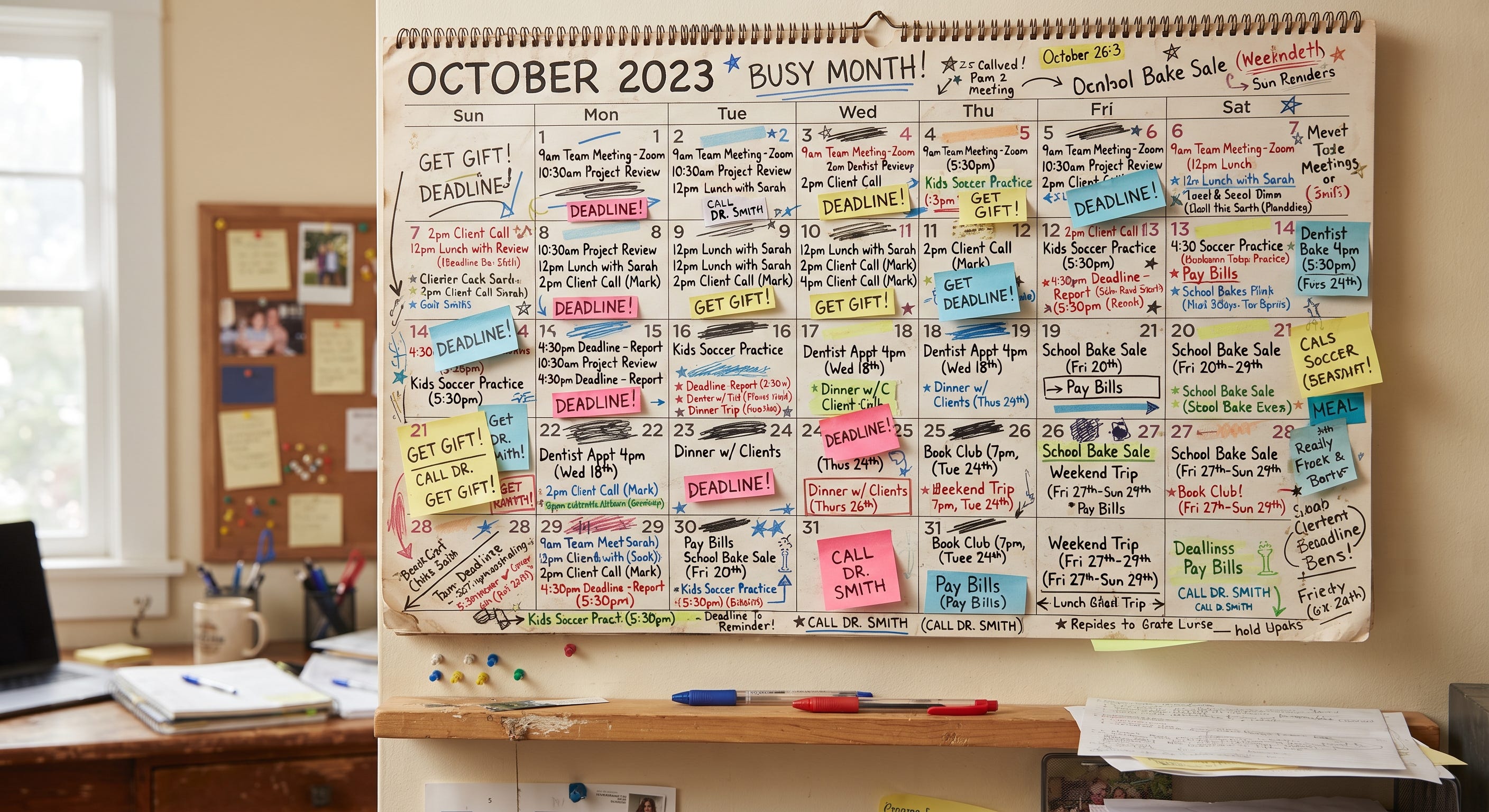
We have started to confuse busyness with efficiency. A full calendar, a fast reply, a long list of tasks ticked off: these have become the signs of a good day at work. We praise people who are always “on”. We apologise when we have a quiet afternoon.
But activity is not progress. Being busy tells us how much energy we spend. It tells us very little about whether that energy goes in the right direction.
When efficiency works
To be fair, the efficiency mindset is not wrong. It works well when the goal is clear and precise. If you know what you need to deliver, focus and pace help. You plan, you execute, you remove waste. That is production mode, and every organisation needs it.
The problem starts when we use the same logic for a different kind of task: the step before production. The moment when we do not yet know what we should make.
The step before: the squiggle
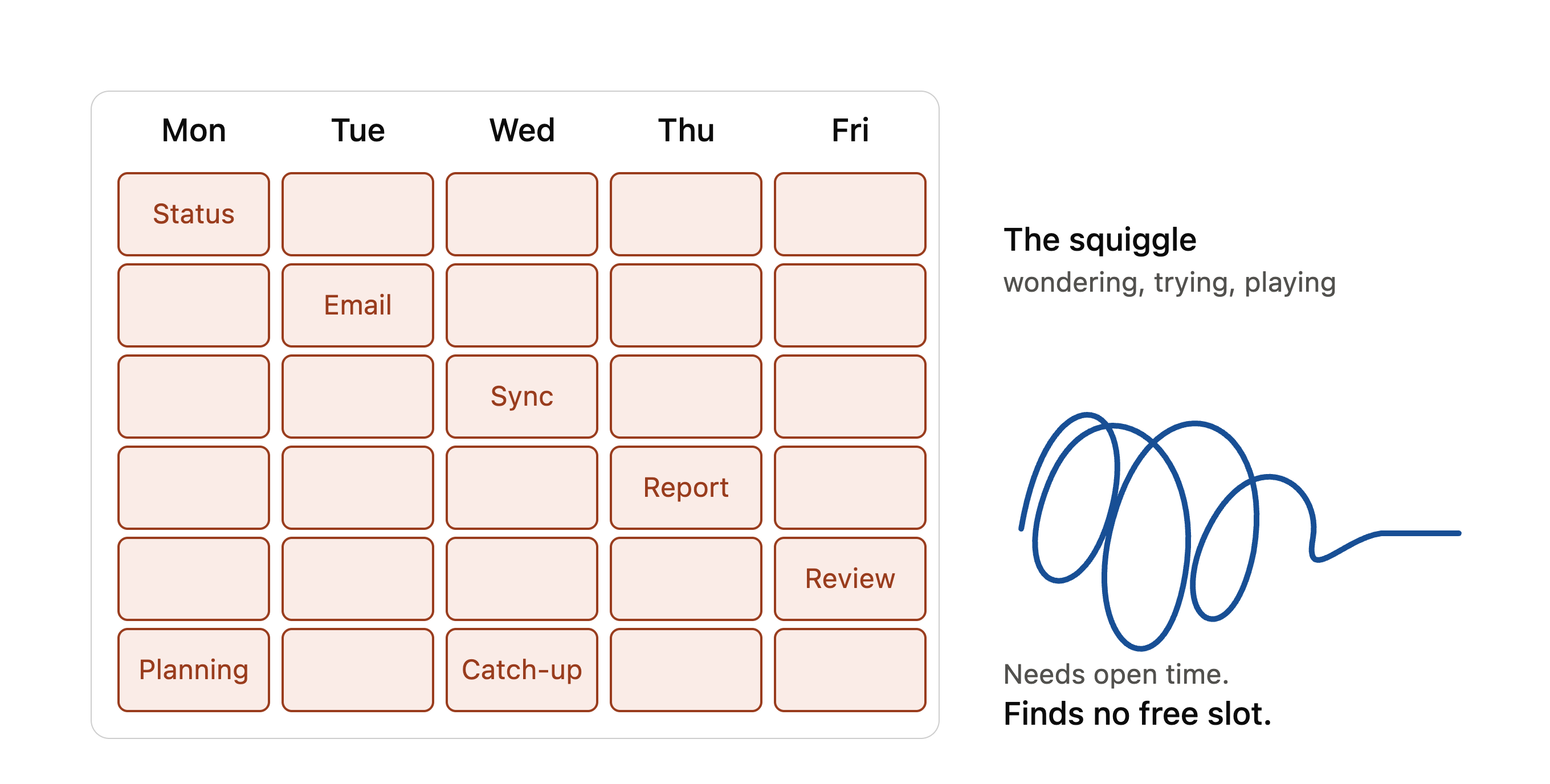
Designer Damien Newman drew a simple picture of the design process. It starts as a messy, tangled line, full of loops and dead ends. Slowly it becomes calmer, and at the end it turns into a straight line toward delivery. He called it the design squiggle.
The straight end is production. The tangled start is where we figure out what to do: research, uncertainty, ideas that go nowhere, insights that come from the side. You cannot skip it. You cannot make it straight by working harder.
In the squiggle, the strategy is almost the opposite of efficiency. You need time to wonder. You need to try different things, play around, and follow a hunch without knowing where it leads. Invention comes first. Production comes after. Rushing the first part does not make the second part faster. It just makes us produce the wrong thing, very efficiently.
Why we skip it
If the squiggle is so important, why do we avoid it? Partly because busyness is a signal. It shows commitment. It makes us look valuable. Open time looks like doing nothing, and doing nothing feels risky when everyone around you is running.
There is also a deeper pattern. In 1991 the organisational researcher James March described two kinds of activity: exploitation, refining what we already know, and exploration, searching for what we do not know yet. Exploitation pays back fast and feels safe. Exploration is slow and uncertain. So organisations drift toward exploitation, and over time they lose their ability to renew themselves.
The squiggle is exploration. Our calendars, metrics and status meetings are built for exploitation. No wonder the squiggle gets squeezed out.
Wandering with a question
I want to be careful with the word “aimless”. The most fruitful wandering usually has a loose question behind it. What is really going on here? What if we did not do it the usual way? Who have we not talked to yet? It is a direction without a destination.
And wandering is not idleness. Trying things, sketching rough prototypes, talking to unexpected people, stepping away so the mind can connect the dots in the background: all of this takes effort. It is simply a different kind of work. We judge it by what we learn, not by what we produce.
The squiggle is also not a one-time phase. Real projects loop back into uncertainty when they meet something new. The real skill is noticing which mode you are in, and switching on purpose. Teams can get stuck in endless exploration too. Converging takes its own kind of courage.
Protecting the squiggle
As a facilitator, this is maybe the most interesting part of the job. Much of what we do is design the conditions for the squiggle. We make room for not-knowing. We slow a group down when it rushes to solutions. And then we help it converge when the time is right.
A few things help, for facilitators and leaders alike:
Give explicit permission. People will not wander if it looks like slacking. Say out loud that this phase is for exploring, not delivering.
Name the mode. Tell the group whether you are opening up or closing down. Mixing the two is where most frustration comes from.
Frame a question, not an answer. A good open question gives wandering a direction without fixing the destination.
Make learning visible. Share what you tried, what surprised you, what you dropped. This turns “doing nothing” into recognisable work.
Protect the time. Put exploration in the calendar like any other commitment, so it does not lose to the next urgent task.
From figuring out to doing
Efficiency is a good servant for the straight part of the line. It is a poor master for the tangled part. Before we can produce something new, we have to invent it, and invention needs time that does not look productive.
So the next time you feel guilty about an afternoon spent wondering, ask yourself which part of the squiggle you are in. If you are still figuring out what to do, being less busy might be the most productive thing you can do.
I hope this post, made sense and you found it useful.
If “HELL YEAH!”, please like it and share it in social media so more people can get can also benefit from it :-)
I would also appreciate if you subscribe, and give some comments here if you wonder something and want to give me some feedback. I would love to read your input here!
If you have a Substack yourself and like my content, I would love for you to recommend “Facili-station” to your subscribers.
Have a nice one!!
Looking for a coach?
In service of those who serve others.
Leadership is hard. Whether you’re stepping into management, leading an entire organization or wondering about your career, the challenges are real: confusing, overwhelming, and sometimes isolating.
I offer a tailored 1:1 or team coaching quarterly program to help you move forward with clarity and confidence. I’ve walked in your shoes, and I’ll work with you to build the resilience and relational skills needed to lead well, beyond just the work.
If this sounds like what you need, let’s talk. Email me at jose@facilistation.com to book a no-strings attached, no-obligation call to talk about your needs and see what I can offer that will fit you the best. Because coaching isn’t expensive. Staying stuck is.
You should see the cost of a life and work that you don’t love... sometimes one good conversation can change your life and your career forever.
Looking for a facilitator and workshop designer?
If you need a workshop designer and facilitator to help you or your team to solve challenges, find solutions, make decisions, and to be more effective an perform better and faster, or a trainer to teach your team on how do this, please contact me at jose@facilistation.com
My workshops are designed to provide the structure required to quickly align and move forward with a plan or idea so you can reclaim time, energy and headspace.