

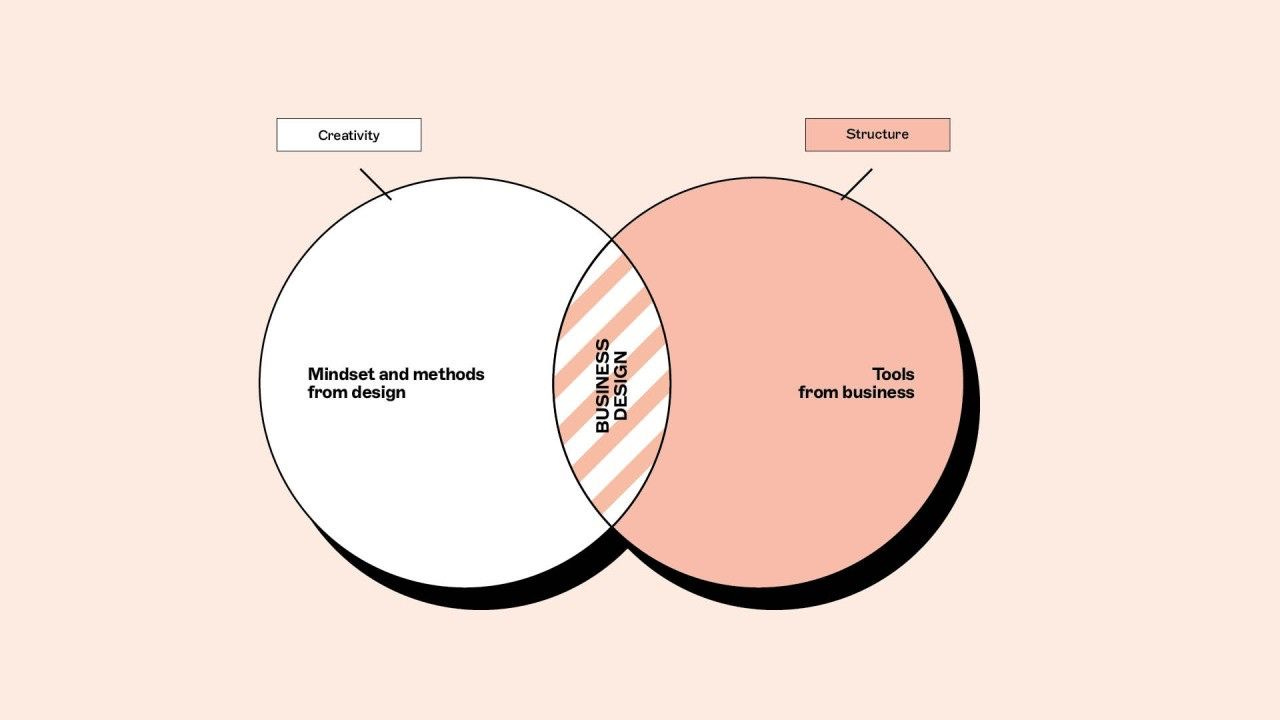
Business design refers to the practice of applying design thinking and methodologies to business strategy and operations.
It integrates the principles of user-centered design with business principles to create, improve, and innovate business models, processes, and strategies.
Business design aims to align the needs and experiences of customers with the goals and capabilities of the organization, fostering innovation and creating value.
Key components of business design include:
User-Centered Approach: Understanding the needs, behaviors, and preferences of customers to create solutions that are desirable and effective.
Holistic Perspective: Considering the entire ecosystem of the business, including stakeholders, market dynamics, and operational capabilities.
Prototyping and Iteration: Rapidly developing and testing prototypes to refine ideas and approaches before full-scale implementation.
Interdisciplinary Collaboration: Bringing together insights and expertise from different disciplines, such as marketing, operations, finance, and technology, to create well-rounded solutions.
Strategic Alignment: Ensuring that design solutions are aligned with the strategic goals and vision of the organization, leading to sustainable business success.
By combining these elements, business design helps organizations create innovative solutions that are both user-friendly and strategically sound, driving growth and competitive advantage.
What is the value of business design?
Business Design is valuable because it connects customer needs, organizational capabilities, and financial viability into a coherent strategy and operating model.
In simple terms:
Service Design helps create better experiences.
Business Design ensures those experiences can be delivered sustainably and profitably.
The value of Business Design includes:
1. Reducing the risk of innovation failure
Many organizations develop products and services that customers like but that are difficult or expensive to deliver. Business Design tests desirability, feasibility, and viability together before major investments are made.
2. Aligning strategy and execution
Business Design translates strategic ambitions into concrete business models, value propositions, partnerships, revenue streams, governance structures, and operational capabilities.
3. Creating customer-centered business models
Rather than starting from internal structures, Business Design starts from customer and stakeholder needs and then designs how the organization can create, deliver, and capture value.
4. Improving cross-functional collaboration
It creates a common language between leadership, finance, operations, technology, marketing, and design teams. This helps organizations make better decisions and avoid siloed thinking.
5. Identifying new growth opportunities
Business Designers look beyond incremental improvements and explore new markets, services, partnerships, ecosystems, and revenue models.
6. Supporting transformation
Whether in the public or private sector, Business Design helps organizations redesign how they operate, not just what they offer.
Business Design in the public sector
For municipalities and public organizations, Business Design can help:
Design more effective citizen services.
Improve resource allocation.
Reduce waste and duplication.
Create sustainable operating models.
Align policy goals with service delivery.
Build stronger partnerships across sectors.
A practical definition
A Business Designer asks:
“How can we create value for people, deliver it effectively through the organization, and sustain it economically over time?”
This is why Business Design is increasingly becoming a critical capability in innovation, transformation, and service development initiatives across organizations such as IDEO, McKinsey & Company, Accenture, and many public-sector innovation teams.
In public sector (my own filed and domain), Business Design can be particularly powerful because it helps bridge the gap between designing great citizen experiences and ensuring that the municipality has the governance, capabilities, funding, and partnerships needed to deliver those experiences at scale.
I hope this post, made sense and you found it useful.
If “HELL YEAH!”, please like it and share it in social media so more people can get can also benefit from it :-)
I would also appreciate if you subscribe, and give some comments here if you wonder something and want to give me some feedback. I would love to read your input here!
If you have a Substack yourself and like my content, I would love for you to recommend “Facili-station” to your subscribers.
Have a nice one!!
Looking for a coach?
In service of those who serve others.
Leadership is hard. Whether you’re stepping into management, leading an entire organization or wondering about your career, the challenges are real: confusing, overwhelming, and sometimes isolating.
I offer a tailored 1:1 or team coaching quarterly program to help you move forward with clarity and confidence. I’ve walked in your shoes, and I’ll work with you to build the resilience and relational skills needed to lead well, beyond just the work.
If this sounds like what you need, let’s talk. Email me at jose@facilistation.com to book a no-strings attached, no-obligation call to talk about your needs and see what I can offer that will fit you the best. Because coaching isn’t expensive. Staying stuck is.
You should see the cost of a life and work that you don’t love... sometimes one good conversation can change your life and your career forever.

Looking for a facilitator and workshop designer?
If you need a workshop designer and facilitator to help you or your team to solve challenges, find solutions, make decisions, and to be more effective an perform better and faster, or a trainer to teach your team on how do this, please contact me at jose@facilistation.com
My workshops are designed to provide the structure required to quickly align and move forward with a plan or idea so you can reclaim time, energy and headspace.
I think we talk way to little about business design today.
Thanks for bringing some light on something we should talk more about.